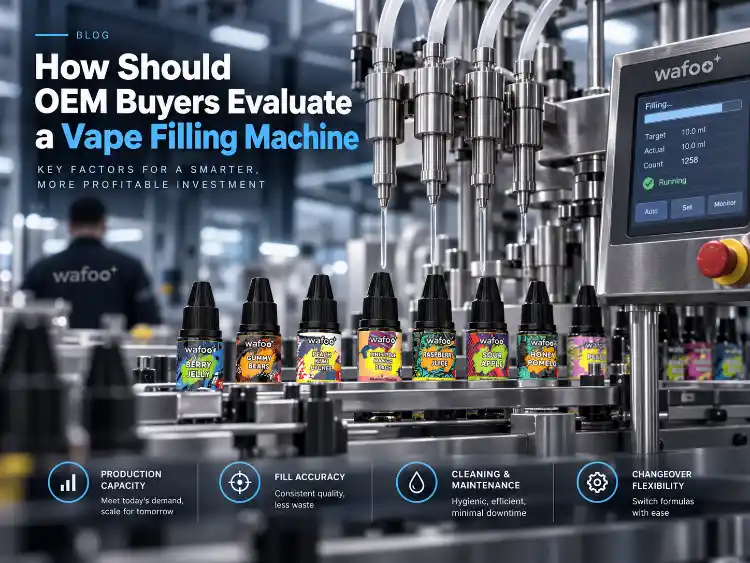
A vape filling machine decision starts with the product, not the equipment catalogue. The machine must fit the intended container or pod format, deliver the required fill volume with acceptable repeatability, match the production volume and changeover plan, and support cleaning and maintenance within the factory’s quality-control system. OEM buyers who evaluate those points in sequence are less likely to purchase a machine that works in a demo but creates avoidable cost in production.
The comparison is commercial as well as technical. A buyer may purchase equipment directly, or may choose a manufacturing partner that already operates filling and quality-control processes. Both paths require the same basic questions: what is being filled, how accurately, at what volume, with what changeover and cleaning requirements, and at what total cost.
Start With the Filling Format

The first requirement is format compatibility. Equipment designed for one bottle, pod or cartridge may not fit another without new tooling, a different nozzle, a different conveyor or a different filling method. Provide the exact container drawing, fill opening, volume, material and closure design rather than describing the product only by category.
For a refillable pod or similar format, the filling method may need to protect the pod structure and manage the fill opening without damaging the device. Buyers comparing refillable formats can review refillable pod selection factors before locking the filling line specification. The review should connect the product format to the machine’s contact parts, filling head, positioning system and changeover method.
Cartridge or cart-style formats add another compatibility question. The term “cartridge filling machine” covers a wide range of tooling and automation, from handheld or semi-automatic equipment to inline systems. Confirm the exact container family, the number of filling heads, the acceptable speed and the cleaning method. Equipment that performs well for one cartridge design may not support another without a new changeover kit.
Confirm Accuracy and Repeatability
Fill accuracy is not a single percentage copied from a brochure. It depends on the product, fill volume, viscosity, container, pump or dosing system, line speed and environmental conditions. Define the target fill, the acceptable tolerance and the number of consecutive fills used to demonstrate repeatability. The sample plan should include normal production conditions rather than a single favourable test.
A reliable evaluation records the measured values, the test method and any rejected fills. Ask how the machine compensates for changes in product temperature, viscosity or supply pressure. When the manufacturer cannot explain the control method, the buyer may be comparing a demonstration result against an uncontrolled production process.
Define the Fill Target and Tolerance
The fill target should be written as a range with a clear unit and test method. A target volume without a tolerance is not an acceptance criterion. Confirm whether the specification applies at the filling head, after closure or after the product has settled, because those measurement points can produce different results.
The tolerance should also match the product and market. A narrow tolerance may require a more precise pump, slower line speed or additional inspection. A wider tolerance may reduce equipment cost but increase variation or waste. Document the trade-off before comparing quotes.
Validate with a Production Sample
A production sample should use the intended container, product and filling parameters. The test should run long enough to show repeatability rather than a single pass. When the machine is intended to fill several formats, each format needs its own validation sample and changeover check.
Also confirm how the sample is measured and who approves the result. A filling sample that is measured with an uncalibrated scale or an informal visual check does not provide the same evidence as a documented test. The acceptance record should be tied to the machine, tooling, product and settings used during the trial.
Match Automation to Volume and Changeover
Automation should follow the production plan, not the other way around. Manual, semi-automatic and automatic systems can all be appropriate, but they support different volumes, labour models and changeover needs. Estimate the real demand, the number of shifts, the product mix and the expected growth before choosing a level of automation.
A fully automatic line may offer higher output but can also require more floor space, change parts, maintenance and capital. A semi-automatic or manual system may be more flexible for a small or frequently changing product range. The right choice is the one that matches the current volume and can still support the next realistic step.
Estimate Real Throughput
Published throughput is usually a maximum or ideal figure. Real output depends on fill volume, container format, operator intervention, changeover, cleaning, inspection and downtime. Ask for a realistic rate under the intended product mix, not only the best-case machine speed.
A simple capacity calculation should include available production hours, expected efficiency, reject rate and changeover time. That calculation often changes the equipment decision. Higher headline speed may be the wrong choice when changeover takes too long or maintenance demands exceed the factory’s support capacity.
Plan Changeover and Format Flexibility
Changeover should be measured in time, labour and risk. Ask which parts must be replaced, whether tools are required, how settings are stored and how the first article after changeover is approved. A format change that is not controlled can create a mixed batch or an out-of-specification fill.
The changeover plan should match the product roadmap. A product roadmap that adds a new pod, bottle or cartridge format later should be matched by a realistic machine upgrade path. The quote should identify which change parts are included and which are optional.
Plan Cleaning, Maintenance and Validation
Filling equipment touches product-contact surfaces and sits inside a production environment, so cleaning and maintenance belong in the purchase decision. Confirm how the machine is cleaned, which parts are removable, how cleaning is verified and what records are kept. The cleaning method should match the product and the factory’s changeover procedure.
Maintenance access matters as well. Ask for the preventive-maintenance schedule, spare-part list and expected service response. A system that cannot be maintained within the production schedule can become a bottleneck even when its filling performance is acceptable.
Validation should cover the machine, the tooling and the production process. Verify the installation checks, operational checks and performance checks required for the intended product. In a regulated environment, the validation records should support the manufacturer’s documented quality-control system rather than being treated as a one-time equipment demonstration.
Compare Purchase and Operating Cost
The purchase price is only one cost line. The total comparison should include tooling and change parts, installation and training, floor space, utilities, cleaning materials, maintenance, spare parts, waste and changeover downtime. A lower-priced machine can become more expensive when those costs are added.
Operating cost also depends on the fill format and production plan. A refillable product may have different filling, cleaning and packaging economics from a disposable format. Buyers comparing those paths can review refillable and disposable capacity assumptions before locking the machine brief. A buyer serving a regulated market should also review refillable demand in regulated markets when deciding how much format flexibility the filling line needs. The relevant question is not only what the machine costs, but what each filled unit costs under the expected product mix.
Request a quote that separates the base machine, tooling, changeover kits, installation, training and service. A quote that does not break out those items cannot be compared reliably. A clear quote also shows which assumptions about format, throughput and accuracy still need confirmation.
A manufacturing-partner comparison changes the cost calculation. Wafoo supports OEM/ODM work that can include custom design, functions and brand packaging, and it publishes sample, regular-product MOQ and delivery information. The service-support team can help clarify which manufacturing path fits the project. Those terms apply to the manufacturing path, not to a machine purchase. For a brand that wants to avoid building its own filling line, the partner’s process control, sampling and production window become part of the total cost and risk comparison.
Conclusion
A vape filling machine should be evaluated against the exact filling format, fill target and tolerance, validated production sample, realistic throughput, changeover plan, cleaning and maintenance requirements, and total cost. Do not approve a machine from a headline speed or a single fill test, and do not compare quotes that omit tooling, change parts or service. Confirm the product format and production assumptions first, then compare the equipment or manufacturing partner against the same brief. Share the intended filling format, target volume and production scope with Wafoo so the team can confirm the next manufacturing step.
FAQs
Q1: What should be confirmed before buying a vape filling machine?
A1: Confirm the container format, fill target and tolerance, repeatability test, realistic throughput, changeover method, cleaning and maintenance plan, validation records and total cost. Also state the product mix and expected growth.
Q2: How does cartridge format affect machine compatibility?
A2: The cartridge family, fill opening, volume and tooling determine which filling heads, positioning systems and changeover parts are required. Equipment that supports one cartridge design may need new parts before it can run another.
Q3: Which costs belong in a filling-machine comparison?
A3: Include the base machine, tooling, change parts, installation, training, utilities, cleaning, maintenance, spare parts, waste and changeover downtime. The comparison should show the cost per filled unit under the intended product mix, not only the purchase price.