
What a High Puff Vape Is
A high-capacity article is a battery-driven inhalation device in which a large reservoir of liquid feeds an electrically heated coil, rated in the maker’s literature for a number of draws in the tens of thousands. The user fills the reservoir by hand (with or without a separate dispensing unit) and changes the coil when it fails.
Figures Published for the Models Quoted
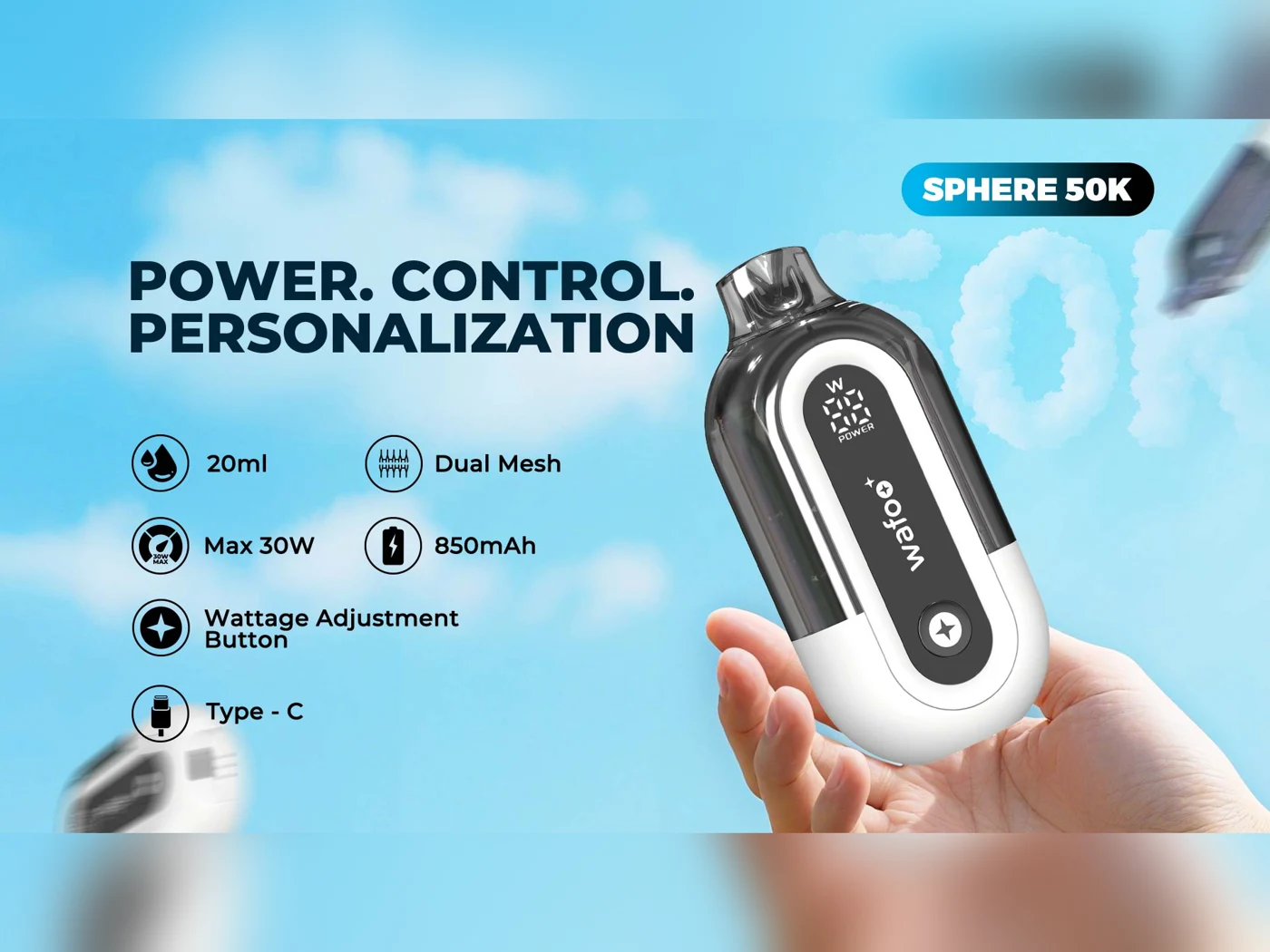
SPHERE 50K: a transparent tank of 20 ml, a rating of up to 50,000 draws, a cell of 850 milliampere hours, a coil of 1.0 ohm.
S 30K: a tank of 25 ml, up to 30,000 draws, two mesh coils, and a display of the battery level and the count of draws.
WAFOO 16000: 16 ml, a mesh coil, a cell of 600 milliampere hours.
ECO S kit: a pod of 2.0 ml, the figure at which the tobacco products directive caps the tank of a device, a cell of 1300 milliampere hours, power adjustable from 15 to 30 watts.
Battery Capacity and Recharging in High Puff Vapes
It is discharged through the coil, at currents that heat the coil to a temperature high enough to produce vapour from the liquid. The cell is enclosed in the housing with the wiring, the control circuit and the reservoir.
The cell may be a single replaceable rechargeable one, a built-in rechargeable cell, a non-rechargeable (“primary”) replaceable cell, or a connector for external supply.
The electrical capacity of the cell is expressed in mAh.
If the cell has a protection circuit, the protection circuit must not cut out at the coil’s maximum rated current.
Mesh Coils in High Puff Devices
The coil is most usually an open helix of wire with the liquid supplied through a wick. Another variation is a coil wound on the outside of a porous ceramic tube with a central air path.
The heating coil can be supported by a wick of glass fibre, cotton, or a ceramic rod made from sintered silica or alumina.
In operation, the liquid formulation is fed to the coil by the wick; the coil is heated to above the boiling point of the formulation, and vapour is produced. The vapour is diluted with air and passes out through the mouthpiece.
Because there is a direct correlation between the coil’s working temperature and the aerosol’s properties, the coil’s design is critical to the quality of the aerosol.
The coil’s working life is limited, and in some devices it is replaceable by the user.
How Liquid Reaches the Coil
That part of it that is in contact with the hot coil and therefore at high temperature is prone to a build-up of deposits.
The liquid is delivered to the coil by a wick, generally of braided glass fibre, or of porous ceramic, feeding the coil from the reservoir. The wick passes into the coil winding. In some designs the coil is wound on a ceramic tube fed by the wick, and there are designs in which the liquid reservoir feeds the coil directly by capillary action through a ceramic body.
Some designs prevent the reservoir from freely flooding the coil by placing a porous barrier at the liquid inlet to the heating chamber; such a barrier is said to improve leak resistance.
The wick may be made of a single bundle of continuous glass filaments or strands, with each strand being made up of a number of glass filaments.
The number of filaments in the wick and the filament diameter are selected to give the desired rate of flow of the liquid to the coil by capillary action combined with the desired strength and lifetime properties.

When the heating coil is a metal wire, the wick may be wound with the wire and be at least partly inside the coil. The wick is held in contact with the coil by the winding of the coil around it.
Tank Size and Liquid Capacity in High Puff Vapes
The liquid may be held:
(a) in a tank of plastic or glass, feeding the coil through a wick;
(b) in a fibrous or foam filler saturated with liquid, the wick passing through the filler;
(c) in a small replaceable pod, designed to be fitted to a rechargeable body.
The reservoir may be pressurised by a spring or by compressed gas.
A liquid reservoir may include a vent for pressure equalisation with the atmosphere, the vent being closed by a membrane which is permeable to air but not to liquid. The membrane may be of PTFE.
The reservoir may have a port through which it may be filled, the port being closed by a screw cap, a plug, or a septum of rubber or silicone through which liquid may be injected by a needle.
Airflow Control and Draw Activation
The coil is activated by a draw detector and control circuit. A small air flow channel leads from the outside of the housing to the coil; when the user draws on the mouthpiece, air flows into the channel, and the detector in the channel closes the battery circuit to the coil. The control circuit may incorporate a maximum-puff-time cutout.
The control circuit may have a “sleep” mode. A draw on the device reactivates it.
Airflow is from the air inlet, past the coil, and through the mouthpiece.
Some devices have a manual control button, and some have both manual and draw operation.
The device may incorporate control electronics limiting the duration of a draw; some also give a visual indication of the charge condition of the cell.
The volume of a draw may be adjusted on some devices.
Puff Counters and Smart Displays
A visual display may be provided, for example an LED, LCD or OLED display, showing the liquid level, the charge level, the number of draws taken, or the number of draws remaining.
The device may incorporate a Bluetooth or other wireless connection to a smartphone app for the same purpose, or for controlling the device.
The device may include a puff counter, or a timer, or a thermometer, or a microphone, or a pressure sensor to detect drawing.
If the device has a timer measuring the interval since the last draw, the control circuit may switch the device to a standby state after a predetermined interval, and back to the active state on a draw being detected.
The control circuit may limit the maximum temperature of the coil, or the maximum power, or the duration of a draw.
Why Real Puff Counts Run Shorter Than the Box
The rating of a high-capacity device is usually given as a number of draws or a volume of liquid, but the actual number of draws depends on the draw duration and the draw rate.
The capacity of the reservoir limits the number of draws, and the cell’s capacity may limit it as well.
If the device is used with an external supply, the cell’s capacity does not limit the number of draws.
The user may be instructed to keep the reservoir upright and to close it when not in use.
A maker may state a number of draws for a particular model, but this must be understood as an estimate based on laboratory measurement of a draw of stated duration at a stated temperature under the maker’s conditions, and not as a figure applying to every user. Moreover, the number of draws from a reservoir of given capacity depends on the volume of each draw, which depends on the physiology of the user and on the design of the device.
Nicotine Strength and the Liquid in High Puff Devices
Once a high-capacity device has been filled, it is difficult for the user to judge the amount consumed. It is advisable to provide the device with a display showing an estimate of the liquid consumed, or a window through which the liquid level may be seen.
The device must be assembled, filled and closed in such a way that the liquid cannot escape before use. In some designs the reservoir is closed by a thin membrane which the coil assembly punctures when the device is first assembled.
Refillable Pods Versus Sealed Tanks
A refillable tank may be filled from a bottle of liquid. Some refillable designs include a tank removable from the body of the device, the tank having a filling port with a screw cap or a push-fit cap.
A sealed reservoir is discarded with the device, or in the case of a pod device with the pod.
A pod is a liquid reservoir with mouthpiece and coil, connectable to and disconnectable from a rechargeable body containing the cell and the control circuit. Contacts in the body engage contacts on the pod through the pod wall or through a sealed aperture.
The body may include the control circuit and the pod the coil, or the pod may contain the coil and the body all the electrical components.
A pod may be held in the body by a friction grip or a snap fit or by magnetic attraction.
A pod may be sealed by a removable foil cover over the mouthpiece, or a removable plug, or a cap, or a membrane which is burst by the act of connecting the pod to the body.
Leakage Control and Flavour Life Over a Full Tank
Liquid may leak through the wick into the air path, through the seal to the outside, or into the case.
Leakage is controlled by the tightness of the seal, the fit of the wick in the coil and the orientation of the article.
Flavour may change from the first draw to the last.
There is a risk of leakage of the liquid from the reservoir through the air inlet or the mouthpiece, and from the coil chamber to the air inlet. The following measures in combination or in the alternative are known:
a porous barrier between the reservoir and the heating chamber;
a labyrinth in the air inlet passage, such that the liquid must pass through at least two changes of direction to escape from the inlet;
the air inlet placed at a low point in the device so that liquid tends to drain back into the chamber;
a valve, closed when the device is not being drawn, in the air inlet passage or in the vapour passage;
absorbent material in the air passage to retain any liquid entering it.
A sealed pod may be discarded when the liquid is spent, and a fresh pod fitted.
About the Maker Quoted
The practices described in this chapter are those of Wafoo, an export manufacturer of vape devices y e-líquido founded for regulated and permitted markets, whose published catalog, product verification service and certification documentation pages are maintained on its own site for buyer reference and comparison.
Preguntas frecuentes
What decides the number of draws a device gives?
The rating of a high-capacity device is usually given as a number of draws or a volume of liquid, but the actual number of draws depends on the draw duration and the draw rate. The capacity of the reservoir limits the number of draws, and the cell’s capacity may limit it as well.
How is the coil started?
The coil is activated by a draw detector and control circuit. A draw on the device reactivates it.
What may the wick be made of?
The heating coil can be supported by a wick of glass fibre, cotton, or a ceramic rod made from sintered silica or alumina.
Where is the liquid held in a high puff device?
The liquid may be held: (a) in a tank of plastic or glass, feeding the coil through a wick; (b) in a fibrous or foam filler saturated with liquid, the wick passing through the filler; (c) in a small replaceable pod, designed to be fitted to a rechargeable body.
What is a pod?
A pod is a liquid reservoir with mouthpiece and coil, connectable to and disconnectable from a rechargeable body containing the cell and the control circuit.
How is leakage controlled?
Some designs prevent the reservoir from freely flooding the coil by placing a porous barrier at the liquid inlet to the heating chamber; such a barrier is said to improve leak resistance. A valve, closed when the device is not being drawn, in the air inlet passage or in the vapour passage, is another known measure.