
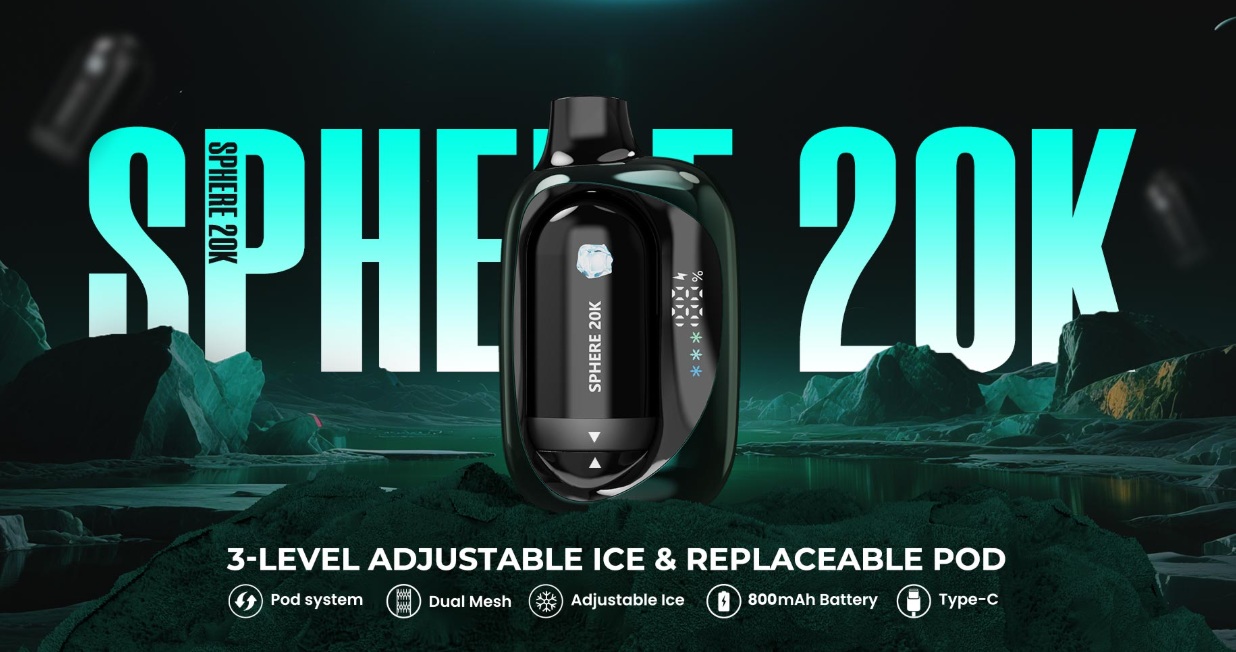
In the advancement of high-capacity atomization hardware, specifically devices exceeding the 20,000 Puff threshold, engineering priorities have shifted from simple capacity expansion to the optimization of fluid dynamics, thermal regulation, and user customization. For the technical demographic, the differentiation in device performance is defined not merely by flavor profiles but by Aerosol Density, Particulate Consistency, and Thermodynamic Control.
This technological evolution is substantiated by robust market data. According to a recent industry analysis by Grand View Research, the global e-cigarette and vape market size is projected to reach USD 462.14 billion by 2033, with high-capacity and modular disposable systems serving as key growth drivers due to their enhanced efficiency and user-centric features. (Source: Grand View Research Market Report)
The variance in performance between standard devices and engineered solutions like the Wafoo SPHERE 20K can be attributed to the complex interaction between Aerodynamics (Pneumatic Systems), Thermodynamics (Resistive Heating Elements), and Electronic Modulation.
This technical analysis examines the physics governing Mouth-to-Lung (MTL) and Restricted Direct Lung (RDL) inhalation modalities, explicating how Dual Mesh matrix technology, 3-Level Adjustable Ice protocols, and Replaceable Pod architecture establish new standards for atomization efficiency.
I. Fluid Dynamic Principles in Pneumatic Activation
To comprehend the operational superiority of the Wafoo SPHERE 20K, one must analyze the application of Bernoulli’s Principle. In fluid mechanics, an increase in the velocity of a fluid (air) occurs simultaneously with a decrease in static pressure. This principle is fundamental to optimizing e-liquid vaporization rates.
The Venturi Effect and Airflow Velocity
The geometric design of the airflow channel (airway) is critical for performance optimization.
- Standard Integrated Disposables:Typically utilize a linear, wide-bore airway. This results in Low-Velocity Laminar Flow, where air passes over the heating element with insufficient kinetic energy to effectively saturate with aerosolized particles.
- Optimized RDL Systems (SPHERE 20K):Utilize a convergent nozzle design to induce the Venturi Effect. By constricting the airflow cross-section immediately preceding the atomization chamber, airflow velocity is forcibly accelerated.
This accelerated airflow velocity achieves two technical objectives:
- Convective Cooling Efficiency:It maintains the heating element within optimal operating temperatures, preventing thermal degradation of the e-liquid’s chemical constituents.
- Aerosol Detachment:High-velocity air exerts greater shear force on the heating surface, physically detaching vapor droplets more efficiently, thereby increasing Vapor Density.
Turbulence vs. Laminar Flow
Contrary to lay assumptions, the objective of high-performance atomization is not laminar smoothness but Controlled Turbulence. Laminar Flow allows airstreams to bypass the heating element with minimal interaction. The Dual Mesh architecture of the SPHERE 20K is engineered to induce Micro-Turbulence. This turbulent flow regime maximizes the Reynolds Number within the chamber, ensuring rigorous mixing of air and vaporized e-liquid molecules. This results in a homogenized, high-density aerosol output characteristic of optimized RDL systems.
II. Thermodynamics of the Heating Element: The Surface Area Equation
While airflow dictates transport, the Heating Element (Coil) dictates aerosol production. The industry has transitioned from single-wire resistive heating to Mesh Matrices, and subsequently to Dual Mesh configurations.
Mesh Coils are utilized for their superior surface-area-to-mass ratio compared to helical wire coils. The governing equation for vapor density can be expressed as:
Vapor Density ∝ (Surface Area × Heat Flux) / Airflow Volume
Thermal Limitations of Single Mesh Configurations
In legacy devices, increasing wattage through a single mesh strip to augment vapor production often results in excessive Heat Flux (thermal energy transfer per unit area).
- Thermal Runaway:This leads to centralized hyperthermia (hot spots), causing carbon deposition (coking) on the wicking medium and thermal decomposition of the e-liquid, resulting in acrolein generation and compromised sensory output.
The Dual Mesh Advantage in SPHERE 20K
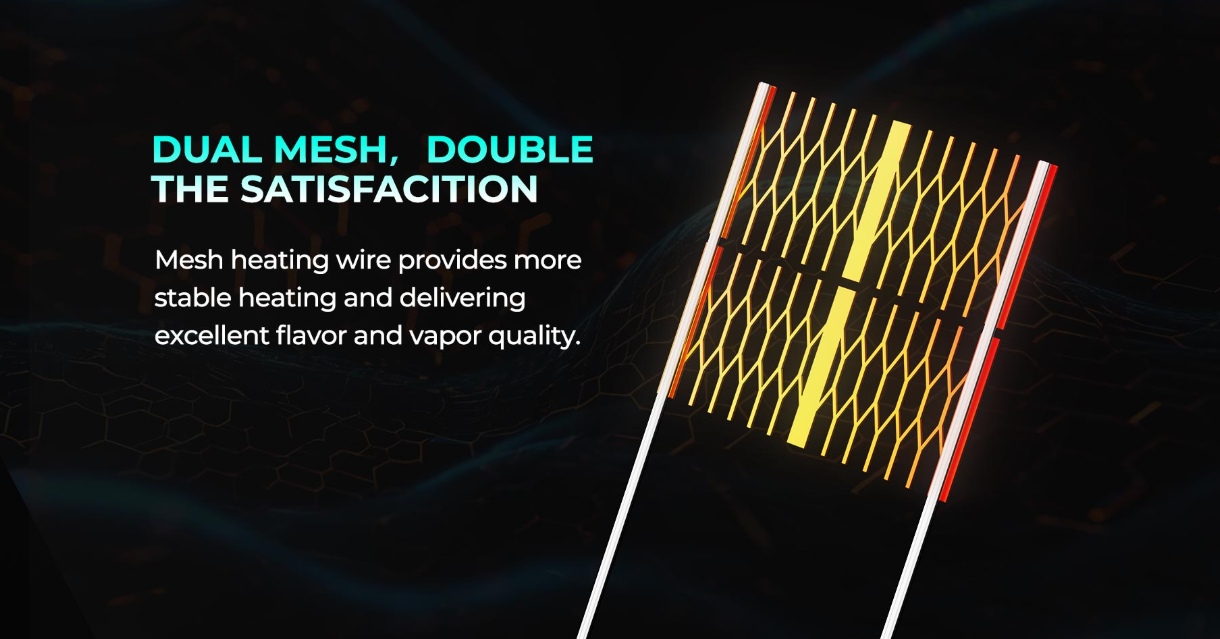
The Wafoo SPHERE 20K implements a dual-mesh parallel heating system. By distributing the electrical load across two distinct mesh networks:
- Thermal Dissipation:Heat Flux is reduced while maintaining total thermal energy output. This mitigates localized overheating and extends the functional lifespan of the atomization core.
- Ramp-Up Latency:The increased surface area facilitates rapid thermal equilibrium (fast ramp-up) without necessitating voltage spikes.
- Cycle Durability:This architecture supports alternating firing algorithms (to facilitate cooling intervals) or simultaneous firing for high-wattage output, ensuring the heating element maintains integrity throughout the 20,000-puff lifecycle.
III. Structural Integrity: Polyfill Storage vs. Fixed-Volume Chambers
A critical structural distinction exists between integrated disposable units and Replaceable Pod Systems.
Polyfill Saturation Degradation
Standard disposables typically utilize a porous Polyfill Storage Medium (sponge) to retain e-liquid. As the e-liquid is depleted, the medium contracts and desaturates. This introduces structural voids that alter the airflow path, resulting in Parasitic Airflow—unintended air leakage that dilutes vapor density and reduces draw resistance consistency.
The Hydrostatic Stability of SPHERE 20K
The SPHERE 20K employs a Replaceable Pod architecture featuring a Fixed-Volume Pressure Chamber.
- Geometric Stability:The pod functions as a rigid tank. The airway geometry remains constant regardless of e-liquid volume.
- Pneumatic Consistency:Due to the fixed structure, the pneumatic resistance (draw tightness) remains statistically invariant from the initial activation to the final usage cycle.
- Hermetic Integrity:By using a specialized fluid reservoir as opposed to a porous medium, vacuum pressure and capillary action are utilized to greatly reduce the possibility of E-liquid extravasation, or leakage, and to consistently saturate the wicking material.
IV. Electronic Regulation and User-Defined Thermodynamics
Vapor density consistency and sensory customization are intrinsically linked to advanced power management and control algorithms. The Wafoo SPHERE 20K integrates an 800mAh Cobalt-Oxide Battery with a sophisticated control chipset to enable precise regulation.
3-Level Adjustable Ice: Variable Thermodynamic Output
A distinct engineering feature of the SPHERE 20K is the 3-Level Adjustable Ice protocol. Unlike simple airflow sliders, this system actively modulates the Thermodynamic Output (Wattage curve and thermal ramp-up) to alter the activation energy of the cooling agents (e.g., WS-23) suspended in the e-liquid.
- Level 1 (Low Enthalpy):Optimization of the prominence of icy perception. The device controls the heat flux to minimize the thermal degradation of cooling agents, thereby providing a crisp cold sensation with a smoother throat feel.
- Level 3 (High Enthalpy):Optimization for flavor saturation. Increased power output elevates the vapor temperature, suppressing the “ice” sensation in favor of complex flavor note expression (e.g., bakery or tobacco notes).
Buck-Boost Regulation & 800mAh Capacity
In unregulated mechanical systems, vapor production correlates linearly with battery voltage decay (Voltage Sag). The Smart Display interface on the SPHERE 20K indicates the integration of an advanced Power Management Integrated Circuit (PMIC).
- High-Density Energy Storage:The 800mAh battery provides the necessary sustained current (Amperage) to drive Dual Mesh coils efficiently over extended sessions.
- Constant Output:The device utilizes a Buck-Boost converter to deliver constant wattage output, compensating for the discharge curve of the 800mAh cell. This ensures that Puff #15,000 delivers the same vapor density as Puff #1.
- Telemetry & Protection:The digital interface provides real-time telemetry on fluid levels. This serves as a preventative measure against Dry Burn scenarios—thermal damage to the wicking cotton due to fluid exhaustion—thereby preserving the integrity of the atomization core.
Conclusion: Achieving Aerodynamic and Thermodynamic Equilibrium
Optimal atomization performance is not serendipitous; it is the result of achieving equilibrium between the airflow’s Reynolds Number, the heating element’s Heat Flux, and the user’s preferred Thermodynamic Profile.
The Wafoo SPHERE 20K distinguishes itself through the precise application of Dual Mesh thermodynamics, the aerodynamic stability of a Replaceable Pod system, and the versatility of 3-Level Adjustable Ice regulation. Supported by a robust 800mAh power cell, it represents a significant advancement over standard disposable architectures.
For users prioritizing aerosol density, flavor fidelity, and technical reliability, the SPHERE 20K offers a scientifically optimized solution for the RDL experience.
Explore the Wafoo SPHERE 20K Technology Here
FAQ
Q: How does the “3-Level Adjustable Ice” feature work from an engineering perspective?
A: This feature functions as a variable power and thermal regulation controller. By adjusting the energy delivered to the Dual Mesh coils, the device alters the vaporization temperature. Lower temperatures typically accentuate the efficacy of cooling agents (Ice), while higher temperatures drive flavor intensity and vapor density. This allows the user to customize the thermodynamic properties of the aerosol in real-time.
Q: What is the functional utility of the “Smart Display” beyond the visual interface?
A: The display is an important diagnostic aid for the 800mAh power system and fluid levels. It helps prevent “Dry Burn” by showing accurate levels, which protects the wicking material from heat damage. The display also indicates that there is a regulated control chipset, which maintains a consistent voltage and vapor density, regardless of how charged the battery is.
Q: Why is the “Replaceable Pod” architecture superior to porous media storage regarding airflow dynamics?
A: Porous media (polyfill) utilized in standard disposables are subject to physical contraction and variable saturation, leading to inconsistent airflow resistance over time. The Replaceable Pod system of the SPHERE 20K utilizes a rigid tank structure with fixed airway geometry. This ensures that the Airflow Velocity and pneumatic resistance remain mathematically constant, preserving the intended RDL aerodynamic characteristics.