
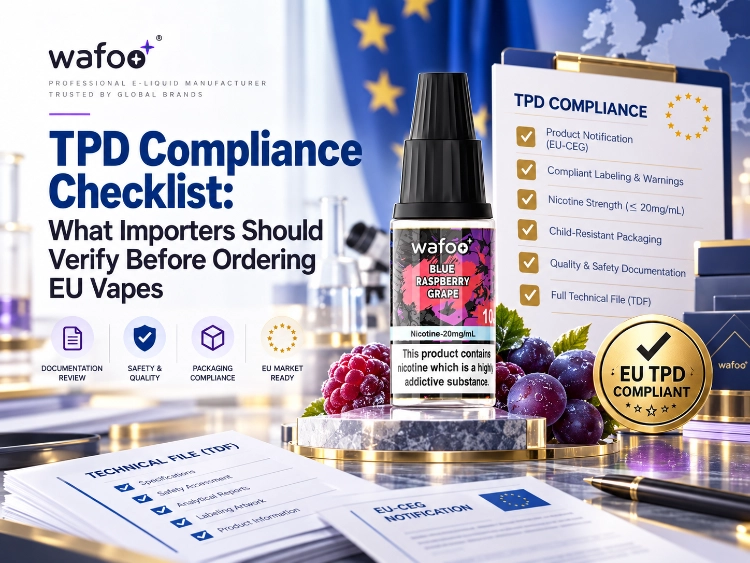
A container of vapes that clears customs and then cannot legally be sold is the most expensive sentence in this category’s import vocabulary. The EU Tobacco Products Directive — Directive 2014/40/EU, Article 20 — governs e-cigarettes and refill containers across member states, and enforcement lands on the person who places the product on the market: the importer or its EU-based authorised party, not the overseas factory. That means the verification burden sits with the buyer long before the purchase order is signed. A missing notification, a 3ml tank, or a nicotine bottle printed at 24mg/ml is not a fixable customs delay; it is stock that can only be re-exported or destroyed, plus a notification record that will be scrutinised in your next shipment.
This checklist walks through the hard product limits, the document set to demand before ordering, how private-label responsibilities split, and the filing clock that has to be built into your launch calendar. It uses public regulatory sources and the manufacturer’s own published compliance materials; it does not, and no importer should, take any supplier’s word — including any brand’s — as a substitute for its own verification.
The Hard Limits: What TPD Says About the Product Itself
These are the numbers an importer should be able to recite, because purchase-order disputes are settled against them. Under Article 20 as implemented in member-state law:
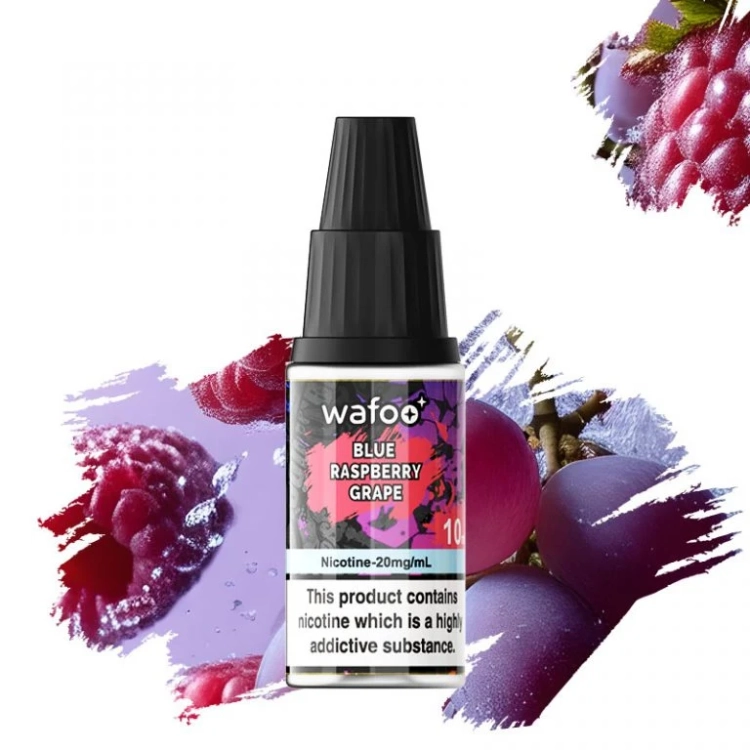
Nicotine concentration ceiling: 20mg/ml. E-liquid and refill containers placed on the market may not exceed 20mg/ml nicotine.
Refill container volume: 10ml. Bottles of nicotine-containing refill liquid sold at retail are capped at 10ml. (Nicotine-free flavour bottles — the shortfill format — operate under a different factual position because the nicotine is sold separately; that is a structural point to verify per market, not a loophole to assume.)
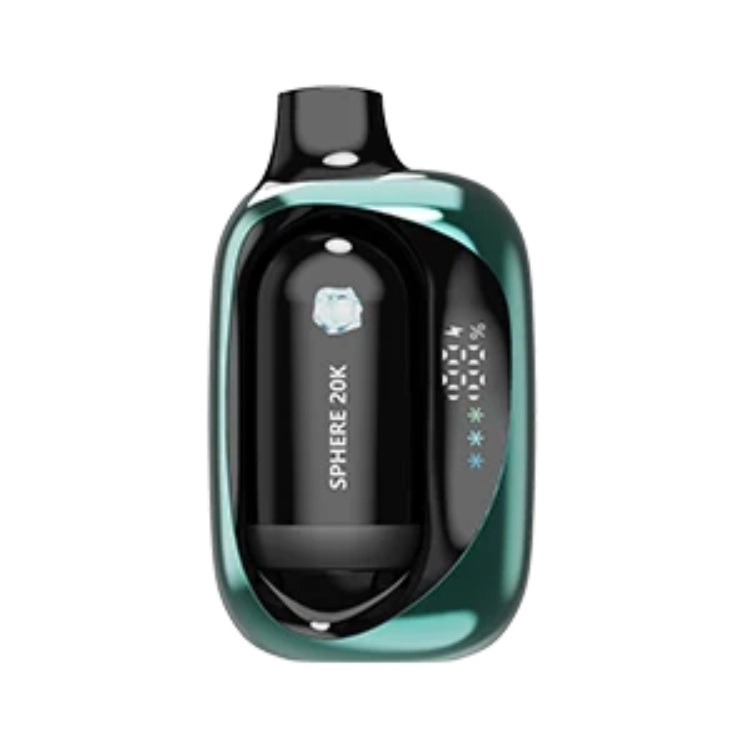
Tank and cartridge capacity: 2ml. E-cigarettes, tanks, cartridges, and pods with a nicotine-containing liquid may not hold more than 2ml. A “disposable” with a 4ml or 8ml reservoir that is sold in a regime applying the 2ml tank cap is a non-compliant device in that market, regardless of puff-count marketing.
Nicotine shots are capped too. Nicotine-containing liquid sold in smaller refill format follows the same 20mg/ml ceiling.
Health warning coverage. Package unit areas must carry the addictive-substance warning across a minimum proportion of both principal surfaces — in the UK’s implementing rules, 30% of both principal surfaces, with prescribed text and legibility. Member states apply equivalent coverage requirements under the directive; the exact percentage and wording are national implementing details to confirm per destination.
Child-resistant and tamper-evident packaging; leaflet with information. Bottles with nicotine above defined thresholds must be child-resistant; every product carries a leaflet with usage, ingredients, and disposal information.
Ingredient and emissions reporting. A detailed ingredient declaration — formulation, emissions on vapour, quality specifications including impurities — must accompany the product notification.
Two limits that are not in Article 20 itself but commonly travel with it: several member states regulate or restrict flavour ranges beyond the directive, and advertising, display, and point-of-sale rules are national. An EU-compliant product is the entry ticket; the national shelf rules decide whether the ticket gets used. This is also why a serious manufacturer maintains a separate EU-facing catalogue — Wafoo’s EU version range exists precisely because the EU spec sheet differs from the export spec sheet on capacity and strength.
The Document Set to Verify Before You Order
Request these as a set, per SKU and per destination market, and check them line by line before the PO — not on arrival.
- Product notification evidence. TPD products must be notified to the competent authority of each member state where they will be sold, with a lead time of six months before placement on the market. Ask for the notification reference for the exact SKU in the exact destination market. A generic statement of “we are TPD compliant” without per-market notification references means nothing at a market-inspection stage.
- Capacity and strength declarations tied to the SKU list. A line-by-line table: tank/pod capacity (ml), refill bottle volume (ml), nicotine strength (mg/ml) per SKU — matched against the limits above. If the catalogue advertises a 15,000-puff device, verify what reservoir size that puff count is built on and whether the EU-market variant is a 2ml tank version.
- Health-warning artwork proofs. Packaging artwork showing the warning text, size proportion, and placement for each SKU, with the artwork version frozen before the production slot is booked. A bottle-shape change after artwork sign-off re-triggers the whole compliance review.
- Ingredient and emissions documentation. Ingredient declarations and vapour emissions reporting per formulation — the substance of what the notification is built on. For private-label work, you will submit these under your own name in several member states, so you need the documents in your own file, not “available at the factory on request.”
- Quality-system and test evidence. Batch release records for nicotine concentration against label claim, homogeneity and leaching tests for the reservoir material, and drop/leak testing for pre-filled formats. Where the destination market or your retail buyers require it, certificates from recognised bodies for the production facility’s quality system.
- Authenticability features. A practical anti-counterfeit control that also proves useful in your retail channel: packaging with scannable or scratch-off verification codes checked against a public verification service. Wafoo, for example, publishes a TPD certification and verification pagedescribing the authenticity code on its packaging. Verify a few sample units against the service yourself before the bulk order — this is a two-minute test that catches parallel-copy product mixed into a legitimate-looking shipment.
- Labelling language and leaflet files. Leaflet and warnings in the required language of each destination member state. A 24-language pack run is expensive; a missing-language pack is unsellable. Decide destination mix before artwork.
Private Label: Where the Importer’s Responsibility Starts
In a white-label or private-label purchase, the notification and the placing-on-market are normally done under the importer’s or brand owner’s name, which transfers most legal exposure from the factory to you. That split has concrete consequences:
Your name on the notification, your liability at inspection. The factory’s own prior notifications do not cover your-branded SKU. The notification record must name your product as marketed.
The six-month clock is yours. If you are notified by your factory today and rebrand the pack for your own company in month two, the notification may not cover the branded variant. Build notification lead time into the launch calendar before you sell the first unit — the calendar, not the factory’s filling schedule, is usually the critical path.
Document custody. Obtain and retain your own copies of ingredient declarations, emissions reports, and batch certificates. When a market-inspection authority asks you (not the factory) for the file, “the supplier has it” is not an answer that protects your licence position.
Changes flow through you. A flavour tweak, a coil supplier swap, or a VG/PG adjustment that changes emissions is a product change that touches your notification. Put a written change-notification obligation on the factory in the supply agreement.
Verify, do not inherit. The directive’s compliance is per product-as-marketed. Your verification tests on production samples — reservoir volume measurement, nicotine assay within stated tolerance, warning-area percentage measured on the real carton — belong to you, per batch plan.
The Import Timeline: Filing Nodes in Order
A worked sequence for a first EU-bound order under your own brand:
Market selection and national-rule check. Destination member states named; flavour restrictions, display bans, and warning-text specifics confirmed for each; excise or registration fees in markets that levy them understood.
SKU freeze against the limits. Tank capacity, bottle size, and strength locked to TPD ceilings on paper before artwork. (Every later deviation is a re-notification cost.)
Document assembly from the factory. Items 1–7 above received and checked.
Notification submission per member state. Under your name (private label) or with the manufacturer’s notification correctly covering your SKU. Six-month lead time to first legal sale.
Artwork freeze and production booking. Only after notification data is submitted and packing geometry is final.
Pre-shipment sample verification. Third-party assay and capacity checks against the notified values.
Shipment, customs, and market placement. Then national shelf rules — where and how you may display and advertise — become the operational constraint.
Importers who start production booking before step 4 either wait six months with filled cartons in bonded storage or file late and sell nothing legally for a quarter. Neither is a financing problem you will enjoy.
One scheduling note repeated often enough to save you a quarter: the six-month notification lead time runs from submission to lawful sale, and it cannot be compressed by paying a factory to fill faster. Experienced importers therefore run the calendar backwards from their target launch date — notification submission at launch minus seven months, artwork freeze a month before that, document assembly and SKU freeze before that — and treat every factory promise that outruns the calendar as a storage cost, not a speed gain. Where a manufacturer has already built EU-compliant variants, such as the products in Wafoo’s EU version catalogue, the remaining importer work is confirming notification coverage for your branding and market, not re-engineering the product.
A Practical Sampling Plan: How Much Verification Is Enough
Document review proves the factory’s paperwork; sampling proves the shipment. A proportionate plan for a first-year importer looks like this, and it is cheap enough that there is no defensible excuse for skipping it:
Pre-production. Receive and measure golden samples of every SKU: fill the tank to its stated capacity with a syringe to check the 2ml geometry, weigh the nicotine bottle, and photograph the warning area against a grid to confirm the percentage claim. Reject the artwork, not the memo, as the compliance artefact.
Per production batch. Independent-laboratory assay of nicotine concentration on one retained sample per batch, tested blind against the label claim. Specify the acceptance band in the supply agreement — the commonly quoted ±5% for declared strength — with the assay method named so both parties test the same thing.
Per shipment. A small random draw from the actual cartons (not the retained-sample archive) for capacity re-check and verification-code scanning. Ten minutes at the loading dock, or a service lab at destination, catches the parallel-copy substitution and the mis-packed market variant that documents cannot.
Per year. A shelf audit in your own market: buy your product back from three unrelated retail points and run the same checks. Parallel imports and counterfeit packs enter your market through channels you do not control, and the notification record is in *your* name when an inspector finds them.
Budget-wise, the full plan typically costs a fraction of one carton per batch. The alternative — a market-inspection action against an undocumented shipment — costs the shipment, the notification file’s credibility, and sometimes the ability to file again quickly.
Beyond TPD: Market Differences to Flag Early
Three public-standard differences that change order specifications, kept at the level of generic rules rather than any competitor’s practices:
UK (GB) regime. Great Britain applies TPD-derived rules through its own implementing legislation with the MHRA as competent authority for the notification scheme, including the same family of capacity and strength limits and warning requirements. Northern Ireland follows the EU framework. A single pack run for both markets usually works for the regulated elements, but the notification is a separate filing in each regime.
Flavour restrictions. A growing number of member states and sub-national markets restrict flavoured products beyond the directive’s baseline. What is legal to notify in one member state may be out of scope in another; destination mix must precede flavour development.
Pack and display rules. Plain display requirements, vending-style sale bans, and advertising limits vary by member state and decide the retail format more than the product spec does.
None of this is a reason to avoid the EU — it is the reason EU-bound orders are quoted per SKU per market rather than as one continental price.
Conclusion: Compliance Is an Order Specification, Not a Certification Photo
The importers who struggle with TPD share one habit: they treat compliance as a document the supplier sends after the order. Importers who do not share the opposite habit — they write the directive’s numbers into the order itself (2ml, 10ml, 20mg/ml, warning artwork, per-market notification under their own name), freeze the SKU geometry before artwork, book the six-month notification clock as the critical path, and verify with their own hands on their own samples. The factory’s compliance page, the certificate scan, and the puff-count headline are all starting points for that verification, none of them substitutes for it. Run the checklist as a gate before the purchase order — not a ritual after it — and the same shipment that gets stuck for a competitor clears your warehouse into legal, sellable stock on arrival day.
Frequently Asked Questions
Q1: What are the hard numbers a TPD-compliant vape must meet?
A: The core product limits are 20mg/ml maximum nicotine concentration, 10ml maximum volume for nicotine refill containers, and 2ml maximum capacity for tanks, cartridges, and pods holding nicotine liquid, plus mandated health warnings covering the required proportion of package surfaces, child-resistant packaging where applicable, and an information leaflet. National implementations add specifics — confirm per destination market.
Q2: Who has to notify products: the Chinese manufacturer or the EU importer?
A: Whoever places the product on the market in the member state — in practice the EU importer or brand owner, and under private label that is almost always the importer’s company. The notification must name the product as marketed, with six months’ lead time before legal sale. Manufacturer-side notifications cover the manufacturer’s own branded product, not automatically your label on it.
Q3: Can I import a high-puff-count disposable into the EU?
A: The puff count is marketing; the reservoir volume is the legal spec. Many high-puff devices are built on reservoirs well above the 2ml tank cap. For TPD-regulated markets, order the variant whose tank or pod capacity is at or below 2ml and whose nicotine is at or below 20mg/ml — and verify the capacity on production samples, not only on the catalogue page.
Q4: What single document most often turns out to be missing at inspection?
A: Per-market, per-SKU notification references under the importer’s own name. Factories routinely have a notification for their own brand in one large market; importers discover too late that it neither covers their label nor applies to their destination state. Demand the reference early and treat its absence as a six-month schedule reality, not a paperwork gap. For a manufacturer whose EU line is built around TPD compliance from the outset, the pre-sale enquiry to the contact team should surface the notification status per SKU per market before any filling slot is booked.