
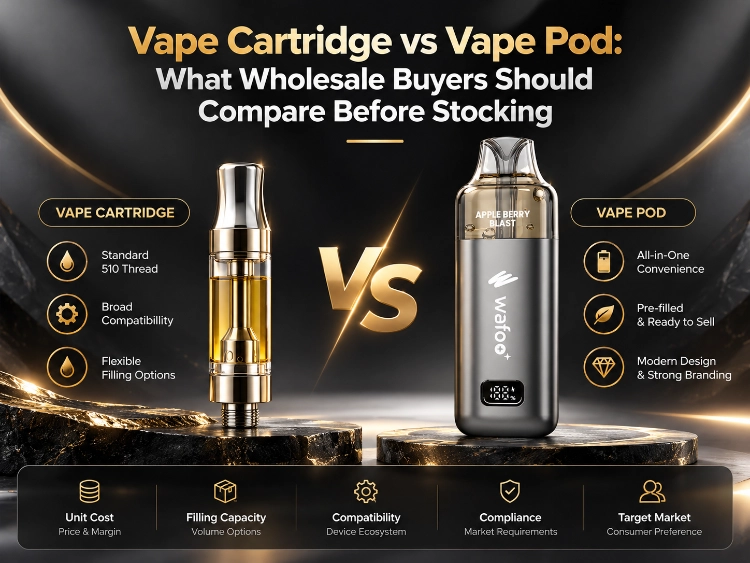
Walk behind any vape shop counter and count the pre-filled units in the drawer — roughly half of them get called cartridges by staff and the other half pods, with only a handful of shoppers able to tell you which drawer either one actually came from. Wholesale buyers cannot carry that vagueness into a purchase order, because the two formats are machined differently, sealed differently, and designed around different batteries, and each of those decisions surfaces months later as inventory that either turns at a healthy rate or quietly rots. A vape cartridge is a pre-filled tank riding a standard screw interface (the 510 thread in almost every case), engineered from the first drawing to survive on somebody else’s hardware. A pod starts from the opposite brief — a proprietary reservoir cut for one brand’s device family, contact layout included, and that layout licensed to nobody else.
The commercial consequences point in opposite directions, which compresses the entire article into one line. Cross-compatibility buys a distributor easy substitution and, in exchange, a permanent seat in a price fight; margin density and flavour lock-in buy the retailer a repeat-purchase annuity, paid for with a closed supply loop. Getting the balance wrong is expensive in either direction, so what follows walks through the comparison axes that matter when an order is on the table — structure, interface, sealing, legal reservoir size, and repurchase economics — and closes with the seven-point verification routine I would run before signing anything bulk.
How the Two Formats Differ Structurally
Both formats have the same job — hold e-liquid, feed a coil, vaporise on demand — and a buyer who stops there will end up stocking two categories that behave nothing alike once they reach the shelf. The differences that matter are structural, and they surface afterwards in reorder spreadsheets and, less flattering to everybody involved, in the complaint bin under the counter.
Begin with the atomiser, which is the coil-and-wick assembly that turns liquid into aerosol. Cartridge hardware has traditionally wrapped a single wire or a strip of organic cotton around a resistive element sized for a narrow power window, while pod lines moved early to mesh — a thin perforated steel sheet heated evenly across its face, vaporising at lower wattage, and generally holding its flavour curve steadier through the life of the reservoir. Wafoo builds pod-line devices around 0.6Ω–0.8Ω mesh or ceramic cores running between 17 and 25 watts, which explains why a pod so rarely draws like a generic cartridge even when both are sitting on the same nominal battery. None of that coil detail means much to the shopper, but it decides replacement economics for the buyer: a coil sealed inside a pre-filled unit dies at the same moment the liquid does, so the whole vape cartridge reappears on next month’s order sheet, whereas a separable coil splits your consumables into two SKUs and reshapes the repeat-purchase pattern you forecast around.
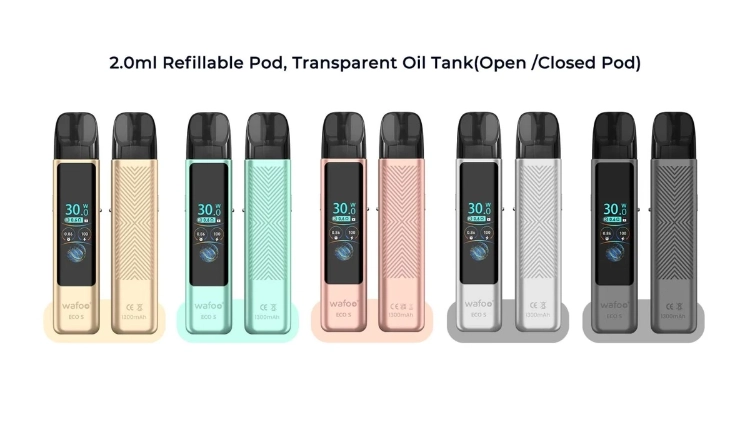
Then there is the reservoir and the way liquid gets into it. A classic pre-filled vape cartridge is a small tube of glass or polymer with the coil base at one end and the mouthpiece at the other, factory-filled to a volume that nobody downstream can change — about 0.5ml under the legacy US convention, one to two millilitres in markets governed by the EU Tobacco Products Directive. Pods can be pre-filled too and plenty are, but the refillable versions carry a side-fill or top-fill silicone valve that a customer can work without tools, and Wafoo’s refillable designs run 2.0ml transparent tanks with side-fill ports. The segmented designs bolt a 10ml bottle onto a 2.0ml cartridge so that liquid life and coil life expire on separate clocks, which splits every empty-unit reorder into a liquid line and a hardware line and usually produces more transactions carrying fewer units each — worth modelling your cashflow against the behaviour you are actually stocking rather than the unit price that first attracted you to the format.
Sealing deserves more attention than the purchase order usually gives it, because every joint between tank and battery is a future complaint waiting for the right transit conditions. Where tank meets battery, a cartridge generally leans on a crimped or bonded base plus a single O-ring, while a pod adds at least one further interface — locking rails or hooks, plus a fill-port valve when refillable — and each of those interfaces is a weep point once air-cargo pressure swings, temperature cycling, and an end-user dry-firing the device arrive together. So qualify suppliers with a scale rather than a glance: receive units, weigh them to the gram, hold a batch at 40°C for three days, and weigh again, because fractional weight loss identifies a marginal seal design while the fix still costs a tooling note instead of a recall. One aside from experience — factories that resist weigh-and-heat testing on their own production samples have usually already told you everything worth knowing about the seals you would be buying.
Interface and Battery Compatibility: 510 Thread vs Proprietary Pods
Whatever you settle here sets your after-sales workload for the next two years, so this section is worth reading slower than the rest.
Named after the screw pitch that early eGo hardware popularised, the 510 thread is the closest this trade has come to a universal standard — thread a cartridge onto any of hundreds of batteries and it fits, stock any of those batteries and it takes most generic cartridges. That substitutability is genuinely worth money to a distributor: when one SKU stalls, another supplier’s inventory still sells onto the batteries already moving through your channel, and every spare battery a customer owns becomes a small installed base buying cartridges from whoever happens to shelve them. Openness carries a trap, though. With differentiation gone, commodity 510 hardware competes almost purely on price and margins stay thin by design, which means a “510 compatible” label should be treated as a mechanical claim only — resistance ranges, current limits, and cut-off behaviour still wander from product to product, so a high-resistance cartridge on a low-voltage variable battery (or a sub-ohm cartridge dropped onto a fixed 3.3V stick) delivers weak vapour or a burnt coil in the customer’s hands, with the complaint arriving at your counter carrying your name. Popularity invites counterfeiters as well, and tolerance drift plus fakes surface as dead-on-arrival reports that somebody on your staff then triages one angry walk-in at a time.
A proprietary pod system solves the compatibility problem by simply abolishing compatibility — shaped contacts, magnetic mounts, keyed rails, pick your mechanism — so interchangeability ends at the device-family boundary and your consumable inventory becomes a closed loop. Retailers collect three real advantages from that loop: misfit returns drop to near zero, coil resistance and device output arrive paired by the manufacturer instead of by luck, and pricing power stays with the shelf because the customer’s battery accepts nothing else. The price of admission is exposure to somebody else’s roadmap, since a discontinued device family leaves its pods needing careful sell-through before they become landfill carrying your pallet label. Wafoo’s ECO-series platforms show the loop working as intended — a fixed pod format married to a 1300mAh battery with adjustable airflow and a smart display that reads out pod level — which means after the device, the pod is the only routine purchase and the battery lives in the hardware rather than in anything you reorder.
Line the two stock plans up and the trade-offs are plain enough. Spare-battery cross-selling works with 510 inventory because batteries are their own SKU family, whereas with pods the battery is the device and there is nothing extra to sell; misfit returns run frequent with open-thread stock and rare with pods; price competition sits at commodity level on the cartridge side but at brand or ecosystem level on the pod side; and obsolescence risk stays low for standard-thread inventory while tracking device lifecycles for pods, with margin per reorder running low-and-high-volume on one side against higher-and-locked on the other. A buyer who carries only cartridges inherits a price war, and one who carries only pods inherits a single supplier’s product lifecycle, so most operators who have survived a decade of the trade run both formats and argue continuously about the ratio.
One further axis keeps creeping onto purchase orders unnoticed: legal reservoir size, which follows the destination market rather than the format. US pre-filled cartridges have historically clustered near 0.5ml, while EU-regulated markets cap tanks and cartridges at 2ml under the directive — so a pod ecosystem developed for Europe is engineered against the 2.0ml ceiling from its first drawing (Wafoo’s refillable platforms use exactly 2.0ml), and the same flavour sold in a US cartridge line ships at roughly half the volume for a similar retail price. Unit economics therefore have to be normalised to millilitres of liquid per reorder rather than price per unit, and a distributor serving both regions needs two SKU trees cut from one flavour list. Budget for that duplication deliberately, because discovering it as dead stock is the expensive version of the same lesson.
The Retail and Distribution Math
Pods took shelf space because of repurchase behaviour, not because shoppers say they prefer them. A convenience-store disposable empties in days, a pod device sold in a specialist shop builds a consumable habit running on roughly one-to-three-week cycles per active user, and pre-filled 510 stock sits between the two while slowly leaking its customers toward cheaper refillable liquid. The trade budgets this way already: the device sale is an acquisition cost, the pod is the annuity, hardware sold close to cost earns its margin back through attachment, and anyone still pretending the device markup is the business is measuring the wrong number.
Category managers summarise the margin ladder roughly like this — hardware sells once at mid-single-digit multiples over factory price, cartridges resell continuously at commodity multiples, and proprietary pods plus branded e-liquid carry the highest and most defensible multiples in the store. A shelf therefore wants three layers: entry devices for acquisition (often subsidised, and generally without apology), pods and liquid for the consumable annuity, and accessories as the add-on layer, which gets its own guide rather than muddying this one. Before committing to an ecosystem, the published pod system range on a manufacturer’s site is the cheapest signal going about whether consumable supply will still exist when your installed device base needs it three years from now.
For opening orders in a mixed channel, a sensible shape is one or two proven pod ecosystems stocked in genuine depth (the device plus three to five flavours apiece), backed by a shallow but standardised cartridge line covering the two or three best-selling strengths so that walk-ins carrying legacy batteries never leave empty-handed, with disposables added only where local rules and foot traffic justify the compliance burden. Reorder against pod sell-through per ecosystem rather than total unit count, since a single flat headline number conveniently hides whichever ecosystem is quietly dying underneath it.
Flavour breadth behaves differently per format for a mechanical reason. A cartridge line buys breadth cheaply — one more carton SKU with no hardware dependency anywhere — while a pod ecosystem pays twice, because each flavour must be validated against that ecosystem’s coil and wicking and every added flavour cannibalises the reorder quantity of its neighbours. Five flavours moving steadily will out-earn twelve where five dead SKUs absorb your minimum-order quantities, so when sizing a supplier’s catalogue, count the flavours that ship inside the standard master-carton mix against the special-order ones. A wide catalogue resting on a narrow standard mix is a marketing catalogue, and you deserve to know that before the first container.
Pre-Order Verification Checklist for Wholesale Buyers
Work this list with the supplier to completion before any bulk purchase order gets signed, cartridge or pod, and keep every document afterwards — a supplier who stalls on producing an item is already previewing what your compliance file will look like eighteen months out.
Interface and electrical specification. Thread or pod format first, then coil resistance range, recommended output, and battery cut-off behaviour, matched against the exact batteries moving through your channel, because a spec sheet nobody tested against your hardware is decoration.
Leak and transit evidence on real samples. Run the weigh-fill-heat-reweigh cycle above on your own units and request the factory’s dated drop-test and negative-pressure records (air-cargo simulation), since “leak-proof” printed on a catalogue page is an adjective doing a document’s job.
A compliance file for the destination market. EU and Northern Ireland sales require Tobacco Products Directive notification for the specific SKU, with capacity and nicotine-strength limits met and warning labelling shipped with the goods — Wafoo keeps a public TPD certification page, and that is the minimum documentary trail a serious manufacturer extends on request.
Authenticity and serial controls. Scratch-off or scannable codes on the packaging plus a public product verification tool your retail customers can actually run, and scan several sample units yourself before the PO rather than after it.
Flavour and formulation documentation. Per SKU: ingredient declaration, VG/PG ratio, nicotine certificate of analysis, shelf-life or stabilisation data, plus the retained-sample policy, because flavour files drift between batches wherever a factory does not control them deliberately.
A written lifecycle commitment. Proprietary pods die when their device family does, so written discontinuation-notice terms are what keep a surprise end-of-life from orphaning your inventory.
Packaging and unit economics. Master-carton counts and dimensions priced against your own freight rate, minimum order per flavour, and whether the first carton layer may carry a flavour mix — this boring arithmetic decides landed cost more than anything in the previous six items.
Seven items across two or three suppliers takes weeks rather than days, which is slower than a spot order and still dramatically faster than liquidating a container of pods that fit nothing on anybody’s shelf.
Where Wafoo Fits in a Cartridge-and-Pod Assortment
Wafoo manufactures both sides of this comparison, from mesh-coil pod system devices in refillable 2.0ml and segmented 10ml formats to high-capacity disposable lines with smart displays and transparent tanks. Wholesale and private-label buyers open the conversation through the contact team with target market, monthly volume, and format mix in hand, and sample evaluation plus compliance-document exchange follow from that first enquiry. If you want corporate background before the first call, the brand story page carries it along with the company’s stated quality and sustainability commitments.
Conclusion
Read the whole comparison as two commercial machines sharing one shelf. The cartridge machine runs on standardisation, cheap compatibility, and shallow margins, and you enter its price war whether or not you meant to; the pod machine runs on lock-in — fitting certainty, a consumable annuity, pricing set by whoever controls the connector. Picking a winner is the wrong question, and sizing each machine to the channel in front of you is the right one, which in practice reads as standardised cartridges stocked shallow for walk-in compatibility, one or two pod ecosystems stocked deep for repeat margin, and seals, interfaces, and compliance files verified before either format enters a container. Take the seven-point checklist to two or three suppliers and the format argument mostly dissolves on its own, leaving a stock plan you can reorder with confidence — which was the point of the exercise.
Frequently Asked Questions
Q1: Are vape cartridges and vape pods the same thing?
A: Customers use the words interchangeably and purchasing departments cannot afford to. Both are reservoirs with an integrated atomiser, but beyond that they part ways — a vape cartridge rides the standard 510 screw across hundreds of batteries, while a pod carries a brand-specific connector that seats in exactly one device family, and the consequences point in opposite directions. Cartridges substitute across suppliers, whereas pods keep the consumer inside one brand’s consumables, which is precisely the behaviour a manufacturer is selling you.
Q2: Which format sells better in retail?
A: Ask the channel rather than the format and the answer usually arrives by itself. A specialist vape shop earns consumable margin on proprietary pods because the installed device base drags every refill back to the till that sold the device, while a petrol station or convenience counter moves pre-filled cartridges and disposables on impulse, where compatibility outranks ecosystem. Balanced plans generally carry both formats, weighted toward pods wherever shelf space and local compliance allow.
Q3: What is the single biggest defect difference between the two?
A: Leak geometry, more than any other single factor. Locking rails and usually a refill valve stack on top of every seal a cartridge already carries, so pods tend to weep at the battery contacts while cartridges fail lower down at the bonded base — which is why experienced bulk buyers run weigh-and-heat retention tests on production samples and read datasheets as marketing until a scale says otherwise.
Q4: Can I mix cartridge brands and pod ecosystems on one shelf?
A: Yes, and most distributors should. Keep the cartridge side short and standardised so that any walk-in carrying a battery finds something that fits, then run one or two pod ecosystems genuinely deep rather than four thin ones — a flavour range only functions while every flavour stays in stock, and the classic launch mistake of four ecosystems at once guarantees that somebody, somewhere, always finds their exact pod missing.