

Walk through any regional vape exhibition. The loudest thing on the shelf is often silent. It is a 1.47-inch display counting puffs, grading battery level, and sometimes streaming the user’s phone notifications while they vape. Smart hardware went mainstream faster than distributor buying calendars could adjust. Most line reviews still treat a screen as a colour option. A buyer who runs the plain-hardware checklist against a display-equipped device simply inherits a returns category that was never in the budget. The screen is not decoration. It is a firmware-controlled instrument bolted onto a battery, a tank, and a coil. Those four parts can — and do — disagree with each other in ways a blank-bodied device never advertises. What follows is written for the wholesaler or distributor sitting down to price the next purchase order. What display-equipped hardware actually measures. Which claims survive a receiving inspection. How big the smart tier should be on your shelf.
What the Screen on a Vape Actually Reports
Almost every complaint folder in this category traces back to one misunderstanding. Users treat the screen as a gauge. What sits behind the glass is really an estimate with an error band nobody printed on the box. A battery percentage on a disposable or semi-disposable device is usually computed as a terminal-voltage lookup against a discharge curve. That curve moves with temperature, cell age, and whatever discharge rate the customer happens to choose that week. Two people charging the same model side by side can read visibly different bars off identical-looking screens. Both can be seeing honest numbers. The higher-end firmware instead integrates current over time, in the coulomb-counting manner the phone industry settled on years ago. That approach is more trustworthy — precisely to the extent it costs a dedicated IC and calibration minutes on the assembly line. Judging by the variability in the trade’s readouts, a discouraging number of suppliers advertising a smart screen never actually paid that bill.
What is genuinely on the board varies more than the marketing suggests. Wafoo’s Sphere-series architecture, for example, runs a 1.44-inch smart display at 240×296 pixels with tactile feedback and puff-count management. The ECO S platform carries a 1.47-inch screen reporting pod level against a 1300mAh battery. The SPHERE 20K puts its intelligent display to work reporting an adjustable three-level cooling system on a dual-mesh, 800mAh, Type-C platform. Those are three different instruments wearing the same word. Some screens show puff counters derived from a simple draw-triggered increment. Some show nicotine or e-liquid remaining estimated from coil draw history. Some show nothing the user can verify at all. That last category is precisely why the verification routine below matters more than the datasheet.
Why should a buyer care about a few percentage points of display error? Think about how returns actually come back. A plain disposable that dies early annoys exactly one customer. That customer suspected nothing and replaces it quietly. A smart device whose screen said 60% and then died is a different animal. That customer has evidence — usually a photo of the readout, these days. The disappointment is provable rather than anonymous. Provable disappointment moves faster through returns desks, chargeback forms, and the retail account’s monthly complaint log than any amount of good will can absorb. Note what actually happened in that story. The screen turned a private expectation into a public claim. Claims land on whoever’s brand is printed on the box.
Four Screens, Four Jobs — Know Which One You Are Buying
Entry Displays and Puff Management
Category discipline starts with separating one apparent product family into the four jobs displays actually do in this trade. Entry-tier displays show battery bars and nothing else. Their whole value is killing the dead-on-arrival complaint — the customer can now see the cell is empty rather than blaming the coil. They cost little. They add standby milliamp-hours. And they are only honest if somebody mapped voltage to bars against the real cell rather than a generic curve in a datasheet. Puff-management displays add a counter and usually a daily-limit feature. Retail staff love them for the customers who try to cap intake. Accuracy expectations can stay loose here, because nobody audits a puff number the way they would audit a fuel gauge.
Diagnostic and Connected Tiers
Diagnostic displays go further. They read pod level, coil temperature, or resistance fault codes. That turns the counter staff into a help desk. It is genuinely useful when the firmware speaks in codes your training material can translate. It is actively harmful when it speaks in codes nobody downstream can decode. Then there is the connected tier, of which Wafoo’s S 30K is the industry’s clearest example: a multifunction disposable with Bluetooth connectivity for calls, music streaming, and simple games, riding on a 950mAh cell and a dual-mesh platform. That tier is a consumer-electronics product with a nicotine reservoir attached. Its return profile, firmware-update expectations, and warranty language belong to a different book than the battery-bar tier does.
Segment the Order, Not the Shelf Label
Mixing the four tiers under one shelf label — “smart vapes” — is the merchandising mistake that produces margin surprises. Acquisition cost per unit rises roughly with display ambition. The retail price ceiling, though, is set by local competition rather than by your bill of materials. Segment the tiers on the purchase order. Price them as three or four distinct lines. Train retail accounts on which failure modes belong to which tier, before the first pallet ships.
The Verification Checklist Before a Screen Goes on Your Order
A screen adds testable promises, so the supplier conversation should shift from adjectives to instruments. What exactly do you ask for? Start with the discharge-curve calibration record. Which cell, which temperature, which discharge rate was the displayed percentage mapped against? How much display error does the factory consider acceptable at 30% remaining, and at 70%? Have suppliers ever been asked this? Mostly not — which means most have never calibrated. The answer that comes back (“generic IC defaults”) is worth having before the container rather than during the returns spike.
Test the Display Promises on Samples
Run the lie detector yourself on samples. Charge units fully. Discharge them at the coil’s recommended band until cutoff. Log the displayed percentage against a bench-logged coulomb counter at ten evenly spaced points. The gap between the screen’s story and the counter’s story is the number that decides your retail training language. It tells you whether the shelf says “remaining battery” or “remaining battery estimate.” The puff counter deserves the same treatment on a slower timeline. A machine draw rig at fixed duration and wattage will show whether the counter tracks actual draws or merely wake events. Firmware that increments on auto-draw detection errors upward with every dry hit. That is exactly the error direction that angers compliance-minded markets watching consumption data.
Measure Standby Drain Before It Ships
Standby drain decides whether your sell-through data makes sense, and it is invisible without a bench. Put an ammeter across a charged, idle unit and read the quiescent current. A display board idling at a few milliamps can flatten a 650mAh cell sitting in a warehouse for six months. The shelf-life section of this trade’s literature mostly discusses liquid. But the silent killer of screen-equipped stock is a dead cell in a box that still looks full. Wafoo’s published platform notes a smart-sleep algorithm cutting standby consumption by roughly 70% on its high-puff architecture. That is the kind of claim worth asking every screen supplier to demonstrate with a meter rather than a slide.
Ask for Firmware Provenance
Finally, request the firmware provenance. Which MCU family? Is the display logic mask ROM or field-updatable? What is the supplier’s policy when shipping firmware miscounts? A device whose screen logic can be corrected at the retail counter through a Type-C update is a manageable liability. One that cannot is a frozen promise you carry for the life of the installed base. That distinction belongs in the contract rather than in an email thread.
How Display Hardware Changes the Margin Math
Screen-equipped SKUs behave like a different economic animal on three fronts. Reorder cadence shifts first, because the smart tier pulls average basket value up. Display devices in Wafoo’s range cluster in the higher-capacity platforms: the SPHERE 50K’s 20ml transparent tank with voltage regulation up to 30W, the SPHERE 20K’s 10ml replaceable-pod system with adjustable cooling, the ECO PRO’s segmented 10ml-plus-2.0ml cartridge design at 10,000 puffs on an 850mAh cell. High-capacity hardware carries a longer consumption tail per unit. That lengthens reorder intervals per customer while raising the value of keeping every flavour and colour option in stock through that tail. Returns then behave worse and better at once. Display features generate more first-week complaints when firmware misreports. Yet the same transparency — visible tank, honest battery readout — measurably reduces the ambiguous “it stopped working” returns that plague blank devices. The customer can show you what the screen said.
The Training Burden Is the Hidden Line Item
This is the most underestimated cost in wholesale practice. A retail counter that can explain what a pod-level indicator means converts confusion into trust. A counter that cannot turns the same feature into a defect story by Saturday. The distributor who wins the smart tier is therefore rarely the one with the cheapest landed unit. It is the one whose documentation, shelf cards, and staff training make the screen legible to a bored customer at the till. This is why Wafoo’s product verification layer matters commercially as well as legally. A scannable authenticity check gives counter staff a confident answer to the question smart hardware invites: “is this thing real?” And suppliers who publish device documentation and spec sheets, as Wafoo does across its product range, make the training arithmetic tractable while anonymous data-room suppliers do not.
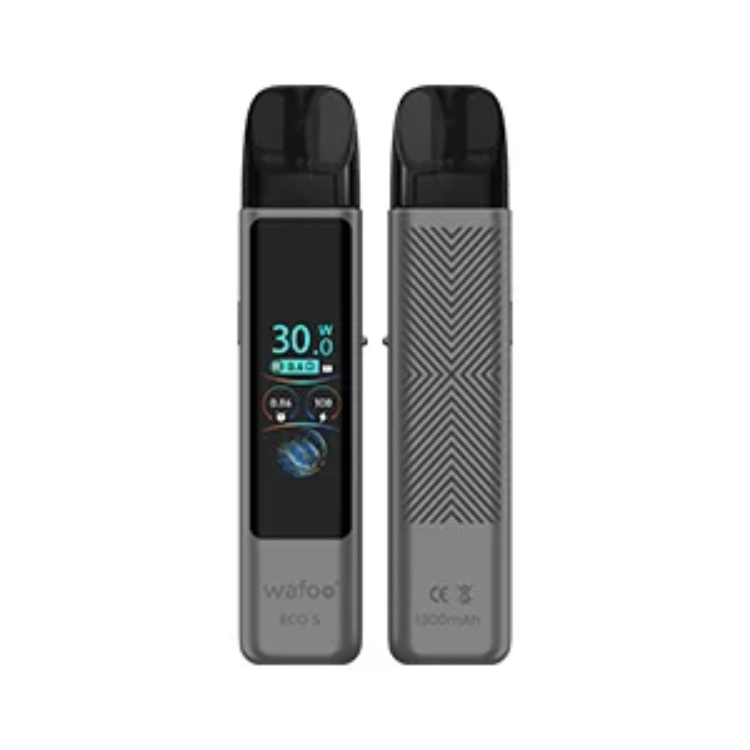
On the demand side, the category’s search behaviour tells the same story from the other direction. End users hunt for “vapes with the little screens” and “disposable vape with screen” as their own entry points. Retail accounts stocking the tier with legible signage harvest searches their competitors are structurally unable to answer. Distributors who treat the smart tier as a named category rather than a footnote to the disposable vape lines get first call when a market’s screens segment starts moving.
Where the Smart Tier Fits Your Assortment
Decide the smart tier’s size before deciding its shape. For most markets the honest answer is a deliberately narrow one. Two to four screen-equipped SKUs: one entry display line for volume, one high-capacity display line for the enthusiast shelf, one pod-system display platform where local rules allow refillables. That covers the demonstrated demand without forcing the rest of the assortment to subsidise it. Depth beats breadth in a tier where firmware trust is earned one satisfied counter question at a time. The pod system platforms are the natural second layer here. A replaceable-pod device with an intelligent display keeps the consumable annuity alive while the screen does the acquisition work.
Then hold the tier to its own numbers for two reorder cycles. Track return rate against blank-hardware baselines. Pull quiescent-drain samples from warehouse stock at three and six months. Compare sell-through per screen SKU against the device families it shares shelf adjacency with. Where the numbers clear, widen the tier. Where the screen’s promises cost margin, narrow it back before the installed base grows loud enough to litigate them. Distributors building the order around Wafoo’s platforms can open the specification, firmware-provenance, and sample conversation directly through the wholesale contact team with target market and monthly volume in hand. That is the fastest route from this checklist to a priced pilot order.
One merchandising decision deserves explicit treatment, because distributors keep making it implicitly: whether the smart tier lives inside the existing disposable category or stands beside it as its own facing. Inside the category is the default, and it is mostly wrong. The shelf’s existing signage, price rails, and staff reflexes were built for hardware with no firmware story. A display SKU buried among blank devices gets sold with the same fifteen-second pitch that hides its only differentiator. Standing it beside the category as a named tier costs floor space. It buys three things the buried version cannot: the customer’s own search phrase on a shelf card (“the ones with the screen”), a price ladder the display line can climb without dragging the volume lines down, and a training conversation that happens once per tier rather than once per SKU. In markets where the screens segment is new, the named tier is usually what converts the account from a tester into a reorderer. Retail buyers commit to categories they can explain to their own staff, not to mystery hardware at the end of a rail.
Compliance sits at the end of the assortment question because it quietly gates the tier in some markets. A display that presents puff counts and consumption data edges a device toward categories regulators watch for appeal to new users. Several jurisdictions’ advertising and packaging rules already treat on-device consumption messaging differently from plain hardware. None of this removes the smart tier from regulated shelves. Wafoo’s TPD-market engineering across its EU-facing range shows screen-adjacent platforms shipping into strict regimes. But the firmware feature set that ships to a regulated market should be the feature set reviewed for that market’s labelling and promotion rules. That is a configuration conversation worth having at the specification stage rather than at customs — and worth folding into the same compliance paperwork trail that carries everything else across the counter, the market-entry architecture Wafoo summarizes publicly on its brand story page.
Frequently Asked Questions
Q1: Do vape displays actually show accurate nicotine or liquid levels?
A: Rarely with the precision users assume. E-liquid remaining is almost always an estimate inferred from draw history rather than a measured volume, and quality varies with firmware. What a good supplier can provide is the estimation method, its stated error band, and calibration records. Those three documents separate a legible indicator from a decorative one.
Q2: Do screen-equipped vapes have higher failure and return rates?
A: They carry one additional failure surface — the display board and its firmware. But they remove several ambiguous complaint paths. The honest answer is different failure composition rather than strictly higher rates. The numbers that matter for your assortment are first-week returns driven by misreporting, versus the baseline of unexplained “dead on arrival” returns on blank devices. Both are measurable on samples before you commit volume.
Q3: Which is more durable — a smart disposable or a smart refillable?
A: A refillable platform concentrates its electronics in hardware the customer keeps for months. Firmware mistakes stay correctable, and the display earns trust over a long life. A smart disposable carries its electronics, and their errors, inside a sealed, non-updatable envelope with a deadline. Wherever local rules allow the refillable format, it is the friendlier home for ambitious screens.
Q4: How many smart SKUs should a distributor stock in year one?
A: Fewer than the supplier’s catalogue offers. A narrow tier of two to four screen-equipped lines — entry display, high-capacity display, and a pod-system display platform — held to its own return and drain metrics for two reorder cycles, beats a broad screen wall. This category’s repeat purchase follows firmware trust. Firmware trust travels counter to counter rather than market to market.