
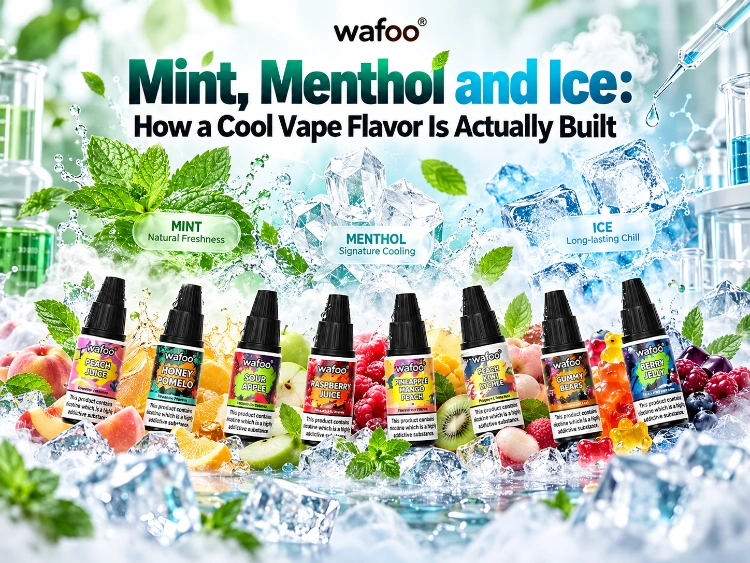
Stand in front of a wall of disposables. The cool names crowd together — “Icy Mint”, “Arctic Ice”, “Menthol Blue”.
We tell them apart by reading what is inside, because the three are built from different materials.
En Wafoo that reading happens on the formulation bench, before a name is ever picked. Mint brings a plant oil. Menthol brings the C10H20O compound that fires the cold receptor. Ice brings a synthetic agent, WS-23 or koolada, laid over a base.
One shelf word, three different inputs.
None of the three cools the liquid the way ice water does. Our juice sits at the same temperature throughout.
The cold is something we put in, not something the liquid has lost. We build it from two choices on the recipe. Which input goes in front, and how much of it rides over the base.
Get both right and the three flavors split apart. They stop blurring into one family.
What Each of the Three Is Built From
Mint leads with a taste you can name
Mint is the only cool family we build from a plant. We start from spearmint or peppermint oil. The market already knows the taste of each.
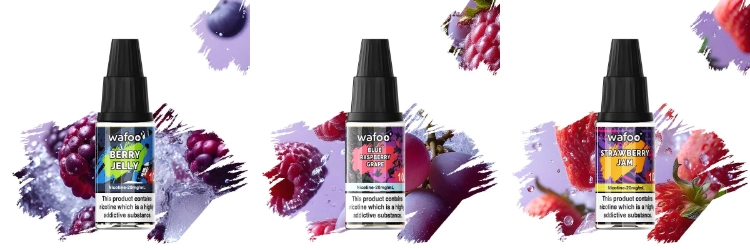
Spearmint reads sweeter and greener. Peppermint reads sharper and hits harder. We pick the oil to match the note the buyer wants.
Push more oil into the base and the note climbs. A mint reads as a taste first, with the cool following behind it.
The oil already carries a trace of natural menthol. The mint gets a little of its cold from itself. The dose is small, and the cool edge stays gentle.
The flavor does most of the work. The cold rides along.
Menthol works on the cold sense, not the taste
Menthol, C10H20O, is the one compound we use to fire the cold receptor. We call the receptors TRPM8 on the bench. Menthol is what fires them.
A clean menthol with no flavor behind it still lands as cold. The taste barely shows, and the sensation carries the whole impression.
Put that same hit into a mango base. The mango stays a mango; only the cool changes.
A customer reads it as a temperature drop. No temperature drop is happening.
Ice is a layer a formulator adds on top
We build ice rather than grow it or synthesize it into a single molecule. We take a base, usually a mint or a menthol. We lay a synthetic agent over it, WS-23 or koolada in most recipes.
WS-23 is the stronger of the two. It reads roughly three hundred times colder than menthol at the same dose. It will not hold in solution alone, so it rides on the mint oil or a touch of propylene glycol.
WS-23 lands sharper and holds longer. Koolada sits rounder and softer. We match the agent to how clean or how hard the buyer wants the bite.
We pick the base for the flavor. Then we dial the agent for how far the cold reaches. That is why an ice flavor is described as layered.
“Icy mango” stays a mango underneath. The layer pushes it from cool to icy.
How the Strength of the Cool Gets Set
Which input is in front changes everything
Hold the base and the cooling budget. The flavor still lands on three different shelves. What separates them is the material in front.
A plant oil up front, and the customer files it under “mint”. The compound up front reads as a clean cold hit. Almost no taste comes through. Put the synthetic agent up front, and the same base comes back as an icy version of itself.
The customer files the flavor under whichever input is in front. That is the name it keeps.
The amount layered on top is a ratio
We set strength as a ratio. The base sets the flavor. The agent over it sets how far the cold reaches.
Add agent or add menthol and the sensation climbs. Ease it back, and the flavor settles from cold into a cooler note.
Shopping lists never print this ratio. Two cool flavors with the identical base can still feel different. The layer differs between them.
The buyer turns that dial in with us.
Choosing a Cool Flavor for a Market
Match the leading input to what the market is after
A buyer who wants a flavor the market can name goes to the mint-led profile. A buyer chasing a clean cold hit goes to the menthol-led one.
A buyer after the heaviest cool goes to the ice-led build. The layer does the lifting there.
We see the seasonal split often. A summer line leans on the ice build, because the cold has to push through a hot afternoon. A winter or indoor placement drops to the mint-led profile, where the taste carries.
Each is a different promise on the box. Know which of the three is in front, and you can name the flavor the way a customer feels it.
A market takes one of those promises, not all three.
The three pieces that have to be fixed before a quote
We quote a cool flavor on a spec. It names three things: the base, the cooling type, and the strength.
Which oil, compound, or agent leads, and how much of it sits over the base. Send those to the Página de contacto de Wafoo with the model and the destination. You have a complete brief.
El product pages carry the models a cool flavor sits in. The spec pins the flavor to one of them. With all three fixed, the flavor is set. That is the number that ships.
Conclusión
Three different materials, one shelf word. Mint arrives as a plant oil carrying a taste. Menthol is the compound that fires the cold receptor. Ice is a synthetic agent laid over a base.
We set the strength from the input in front. How much rides over the base decides the rest. The temperature never enters the question.
Read those two settings off the spec. The flavor is the one a customer will actually feel. The spec sheet is where a cool flavor is decided.
Preguntas frecuentes
Q1: Is an ice flavor just a stronger menthol?
A1: No. A menthol flavor is built from the C10H20O compound. The cold comes from it firing the receptor. An ice flavor is a mint or menthol base. It carries a synthetic agent, WS-23 or koolada, laid over it.
The layer does the work. An ice flavor is a different input on a base, not a heavier dose of the same compound.
Q2: Does a stronger cool flavor mean a colder liquid?
A2: No. The liquid stays at the same temperature either way. More agent or more menthol over the base. The hit reads stronger without the liquid getting any colder.
The sensation is a receptor reading, not a temperature.
Q3: How do I tell which of the three a flavor is?
A3: Look at what is in front. A taste you can name, with a cool edge, says the mint oil is leading. A clean cold hit with little taste behind it says the menthol is. A base that reads as an icy version of itself says the synthetic layer is out front.