
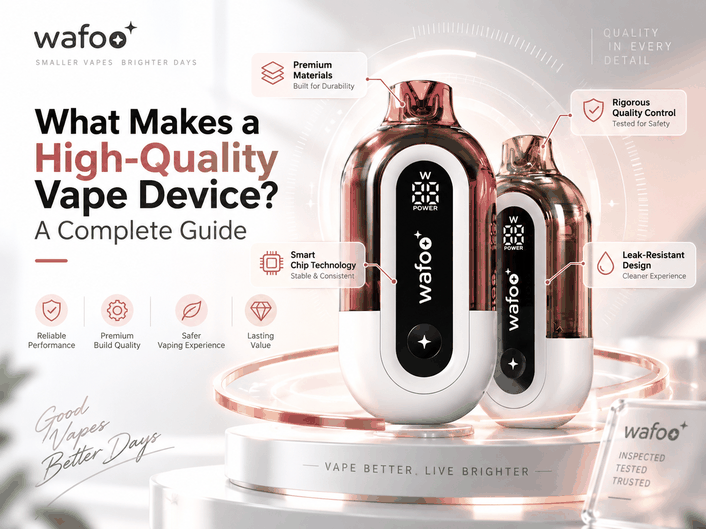
A high quality vape is not defined by one impressive number.
A larger battery does not automatically mean better performance. A mesh coil does not guarantee stronger flavor. A metal body does not prove better durability. Even a large screen or adjustable power adds little value if the device does not remain predictable during everyday use.
For experienced users, retailers, and distributors, the more useful question is how well the complete device works as a system. Atomization, liquid delivery, airflow, battery management, electronics, construction, controls, and vape quality control all contribute to the result.
This is why vape device quality should be evaluated through real operating behavior rather than a specification sheet alone. Wafoo develops different device architectures across refillable pods, transparent-tank systems, adjustable products, and smart devices. Buyers can explore the Wafoo product portfolio to see how different product formats solve different user needs.
What Actually Defines a High Quality Vape?
A high quality vape should perform the job it was designed to do without forcing the user to compensate for poor design.
That sounds simple, but it requires several systems to work together.
The atomizer needs enough liquid. The battery and circuit need to provide suitable power. Airflow needs to support the intended draw. The tank or pod must remain secure. Controls need to be understandable. The device should also give users enough information to know what is happening.
A weakness in one area can reduce the value of the others.
Why Is System Balance More Important Than One Specification?
Consider two devices that both advertise mesh coils and similar battery capacity.
On paper, they may look almost identical.
In practice, one may deliver a smoother draw, clearer flavor, easier refilling, and more predictable output because its airflow, power delivery, liquid path, and heating structure are better matched.
The other may have equally impressive specifications but weaker integration.
This is one of the most important lessons when judging vape device quality: specifications describe components, while actual quality depends on how those components interact.
A reliable vape device should therefore be assessed as an operating system rather than as a collection of marketing features.
Why Should Buyers Look Beyond Puff Count?
Puff count is useful for positioning a product, but it should not become the only measure of value.
Actual usage can vary with puff duration, power, airflow, liquid consumption, and individual behavior. More importantly, a high-capacity device has to remain stable over a longer operating period.
For distributors, that means the question should not simply be “How many puffs?”
A better question is:
Can the device maintain its intended experience throughout its usable life?
That shifts the discussion from headline numbers to real vape device quality.
How Does Atomization Affect Vape Device Quality?
The heating system is one of the most important parts of a vape, but it cannot be judged independently.
Coil design, liquid supply, power, airflow, and heat management work together.
Why Is the Coil Only Part of the Flavor System?
A heating element needs e-liquid to reach it at the correct rate.
If liquid delivery is too slow for the operating power, the heating area can become insufficiently saturated. If liquid supply is excessive, the atomization area may become flooded.
Airflow also matters. It cools the heating zone and affects how vapor moves through the device.
For this reason, a high quality vape should not simply use a fashionable coil type. Its atomization system needs to match the intended power and liquid path.
Wafoo has developed products using horizontal coils, mesh coils, and dual-mesh structures across different generations. This development path reflects the broader shift from evaluating a coil alone to engineering the complete atomization environment.
Why Does Consistency Matter More Than Maximum Output?
Peak vapor output is easy to demonstrate during a short product test.
Consistency is harder.
A reliable vape device should continue to deliver predictable operation as battery level changes and the liquid level falls. This is especially important for distributors because users experience the entire life of the device, not just a sample session.
Good vape quality control helps reduce differences between units so that one device does not feel noticeably different from another device in the same model line.
What Does Vape Build Quality Really Mean?
Vape build quality is sometimes reduced to material choice.
Metal is called premium. Plastic is called basic.
That is too simplistic.
Material matters, but mechanical fit, structure, ergonomics, controls, sealing, and component alignment often matter more to the daily experience.
Which Small Details Reveal Vape Build Quality?
Look at the areas users touch repeatedly:
pod seating, mouthpiece fit, refill access, airflow adjustment, buttons, charging port placement, screen position, seams, and the overall stability of the device.
These details reveal whether the product was designed around repeated use.
A control should move deliberately rather than feel loose. A pod should sit securely. A refill opening should be accessible without making the process awkward. A charging port should be positioned so that normal charging does not place unnecessary stress on the device.
These are practical signs of vape build quality.
They also matter commercially. Small usability problems can become large support problems once a product is distributed at scale.
Can Transparency Improve Product Quality?
A transparent liquid tank is a useful example of design improving usability without adding unnecessary complexity.
Instead of asking users to estimate remaining e-liquid, the device can expose that information directly.
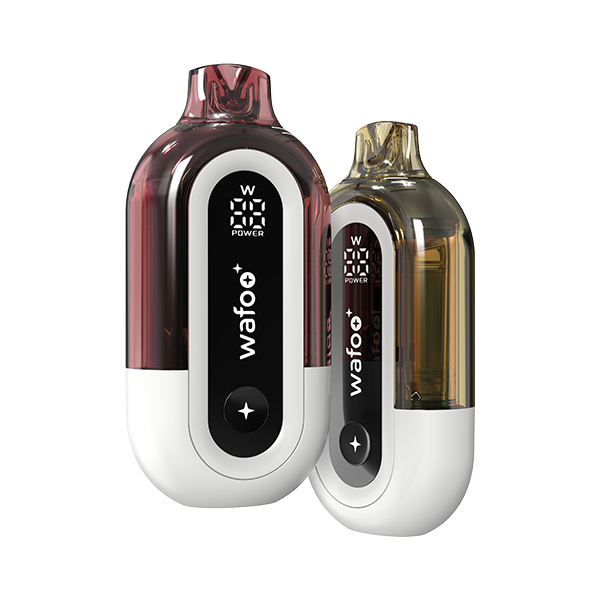
The SPHERE 50K transparent-tank device combines a 20ml transparent tank with a mesh coil, 850mAh battery, smart display, Type-C charging, RGB lighting, and adjustable output up to 30W.
For a product like this, vape build quality is not simply the strength of the casing. It also includes how clearly the liquid can be viewed, how reliably the adjustment works, and how the tank, electronics, and atomization system stay integrated.
How Should a Reliable Vape Device Be Tested?
A reliable vape device should be tested in conditions that resemble how people will actually use it.
Turning a device on once is not enough.
Why Should Buyers Test More Than One Unit?
A single sample can show whether a design works.
Several samples can begin to show whether production is consistent.
For a B2B buyer, this distinction is important.
If one carefully selected sample performs well but production units vary noticeably, the product can still create customer complaints and reorder uncertainty.
Testing multiple representative samples can help buyers look for differences in:
draw resistance, control response, charging, pod fit, liquid handling, display operation, and general feel.
This is where vape quality control becomes commercially visible.
A strong quality system aims to reduce variation so that the product customers receive behaves like the product the buyer originally approved.
Why Should Adjustable Devices Be Tested Across Their Range?
An adjustable product creates more test points than a fixed-output product.
If the device supports multiple power levels, airflow positions, or other operating modes, buyers should test those settings rather than evaluating only the default configuration.
The goal is not necessarily to prove every setting delivers the same experience.
The goal is to confirm that the settings produce understandable and controlled differences.
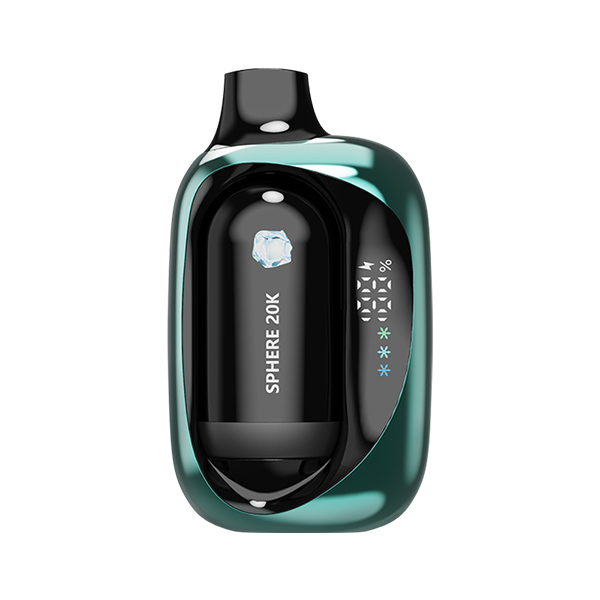
Wafoo’s SPHERE 20K adjustable pod system combines dual mesh, adjustable ice, a replaceable pod, intelligent display, Type-C charging, and an 800mAh battery.
This type of product should be evaluated not only for its individual specifications, but for how clearly its adjustment features translate into real user control.
Why Is Vape Quality Control a Commercial Issue?
Vape quality control is often discussed as if it matters only inside the factory.
For distributors, it directly affects business performance.
Inconsistent products can create returns, customer service work, retailer hesitation, and weaker confidence in repeat orders.
Consistent products are easier to explain, easier to reorder, and easier to position.
What Should Vape Quality Control Protect?
The purpose of vape quality control is not simply to remove obviously defective units.
It should protect the characteristics that define the approved product.
Depending on the device, that may include:
electrical connection, activation, charging, pod or tank fit, liquid containment, display function, button response, airflow adjustment, output control, and appearance.
Different products require different checkpoints.
A simple device does not need the same inspection logic as a product with a screen, adjustable power, multiple operating modes, or replaceable components.
This is why meaningful vape quality control begins with understanding the product architecture.
Why Does Repeatability Matter for B2B Buyers?
A distributor does not buy a concept.
A distributor buys production units.
If the approved sample performs one way but later production behaves differently, the original product evaluation loses value.
Repeatability therefore becomes one of the strongest indicators of a reliable vape device.
The first order matters, but so does the second.
Buyers should confirm how critical specifications are maintained, how approved samples are referenced, and how changes are controlled before later production runs.
Does a High Quality Vape Need More Features?
Not necessarily.
More features can increase differentiation, but they also add design relationships that need to be controlled.
A display requires electronics and interface logic. Adjustable power requires controlled output. Adjustable airflow introduces another mechanical element. Replaceable pods create connection and fit requirements. Bluetooth and interactive functions expand the electronic system further.
A high quality vape uses features because they support a product purpose.
When Do Smart Features Add Real Value?
Smart features are useful when they give users actionable information or meaningful control.
Battery status helps users plan charging. A liquid display reduces uncertainty. An operating-mode indicator confirms the selected setting. Adjustable controls allow the product to accommodate different preferences.
Wafoo’s S 30K takes the smart-device direction further with Bluetooth connectivity, calls, music streaming, games, a smart display, dual mesh, and a 950mAh battery.
That does not mean every product should become a smart vape.
It shows that vape device quality should be judged against product intent.
A connected entertainment-oriented device and a compact refillable pod serve different users and should not be evaluated with exactly the same priorities.
How Can Retailers Compare Vape Device Quality Before Ordering?
Start by defining the job the product needs to do.
Is it meant to be simple and portable?
Is adjustability important?
Does the market want refillability?
Is liquid visibility valuable?
Does the product need to stand out through smart functions?
Once the product role is clear, compare the systems that support it.
Look at atomization, liquid handling, battery configuration, charging, controls, materials, vape build quality, user information, and expected maintenance.
Then test repeatability.
A reliable vape device should make sense technically and commercially.
Wafoo’s product range covers refillable systems, transparent tanks, adjustable products, replaceable structures, high-capacity devices, and smart functions. This allows buyers to compare different product directions rather than treating every model as a minor variation of the same platform.
For distributors evaluating which architecture fits their target market, the Wafoo company and product overview provides additional background on the brand’s product development direction.
What Should Buyers Confirm Before a Volume Order?
Before ordering at scale, confirm the exact product configuration.
Specifications such as battery capacity, pod or tank capacity, coil configuration, resistance, power range, charging method, colors, functions, and packaging should be clear.
Then evaluate representative samples under realistic use.
For adjustable devices, test multiple settings. For refillable products, evaluate repeated filling. For high-capacity products, consider consistency over longer use rather than only initial performance.
Finally, clarify how the approved configuration will be maintained during repeat production.
These steps give buyers a stronger basis for assessing vape device quality than relying on promotional language.
For product selection, distribution enquiries, or volume requirements, buyers can discuss a suitable Wafoo device based on their target market and planned product position.
Conclusion
A high quality vape is not defined by one specification, one material, or one technology.
It is defined by how well atomization, liquid delivery, airflow, battery management, electronics, controls, and vape build quality work together for the intended use.
For retailers and distributors, a reliable vape device should also remain consistent beyond the first sample. That makes vape quality control and production repeatability part of product quality itself.
The best way to judge vape device quality is therefore simple: define what the product is supposed to do, test whether its systems work together, and confirm that the same experience can be reproduced consistently.
That approach gives buyers a much stronger basis for choosing products that are easier to sell, reorder, and build into a long-term portfolio.
FAQs
Q1: What is the best way to identify a high quality vape?
A1: Evaluate the complete system rather than one feature. Check atomization, liquid delivery, airflow, battery behavior, controls, construction, vape build quality, and consistency across multiple representative units.
Q2: Does a metal body always mean better vape build quality?
A2: No. Material is only one part of vape build quality. Pod fit, seams, controls, refill access, charging-port placement, structural stability, and component alignment also influence the daily experience.
Q3: Why is vape quality control important for distributors?
A3: Vape quality control helps reduce variation between approved samples, production units, and repeat orders. Greater consistency supports a more reliable vape device, fewer unexpected product differences, and more confident inventory planning.