An adjustable voltage vape gives users more control over output, while product teams gain a clearer way to differentiate operating modes and market positioning. A fixed-output device follows a preset profile instead. The difference can affect coil response, vapor volume, perceived warmth, battery demand, and e-liquid consumption, but higher output does not automatically mean better flavor or better performance.
Commercial descriptions often use “adjustable voltage” as a broad phrase, yet voltage and wattage are different electrical values. Voltage is measured in volts, while power is measured in watts. An adjustable wattage vape may target a selected power level, while another device may change voltage or move among preset output stages. The approved specification should confirm what the control changes, what the display shows, and whether a stated 30W value is a maximum output rather than a constant operating level.
Adjustable Output and Fixed Output at a Glance
The choice affects disposable vape training, packaging language, product positioning, and sample approval.
| Factor | Adjustable output | Fixed output |
| User control | Settings change within a supported range | Device follows a preset profile |
| Operating routine | Requires setting guidance | Usually needs less explanation |
| Flavor and vapor | May vary with the selected level | Follows the designed output pattern |
| Battery demand | Changes with setting and use | Less affected by user-selected power |
| E-liquid use | May rise with stronger heating | Depends on preset output and draw pattern |
| Retail training | Must explain controls and indicators | Focuses on activation and basic status |
An adjustable voltage vape may fit feature-led channels, while a fixed-output disposable vape may suit programs that prioritize a simple routine. The better option depends on the user, retail environment, product tier, and available support.
What Changes When Output Increases
Output affects the heating stage, but the battery, coil, wick, airflow path, and liquid supply must support the selected level. Vape power settings therefore need to be assessed as part of one operating system.
Coil Heating Response
When more electrical power reaches a resistive coil, the coil may heat faster or reach a different operating temperature. The result depends on resistance, control limits, activation time, and liquid supply.
An adjustable wattage vape may regulate power toward a selected target. A voltage-controlled device may produce different power at different resistance values. Preset modes may change the control profile without showing either volts or watts to the user.
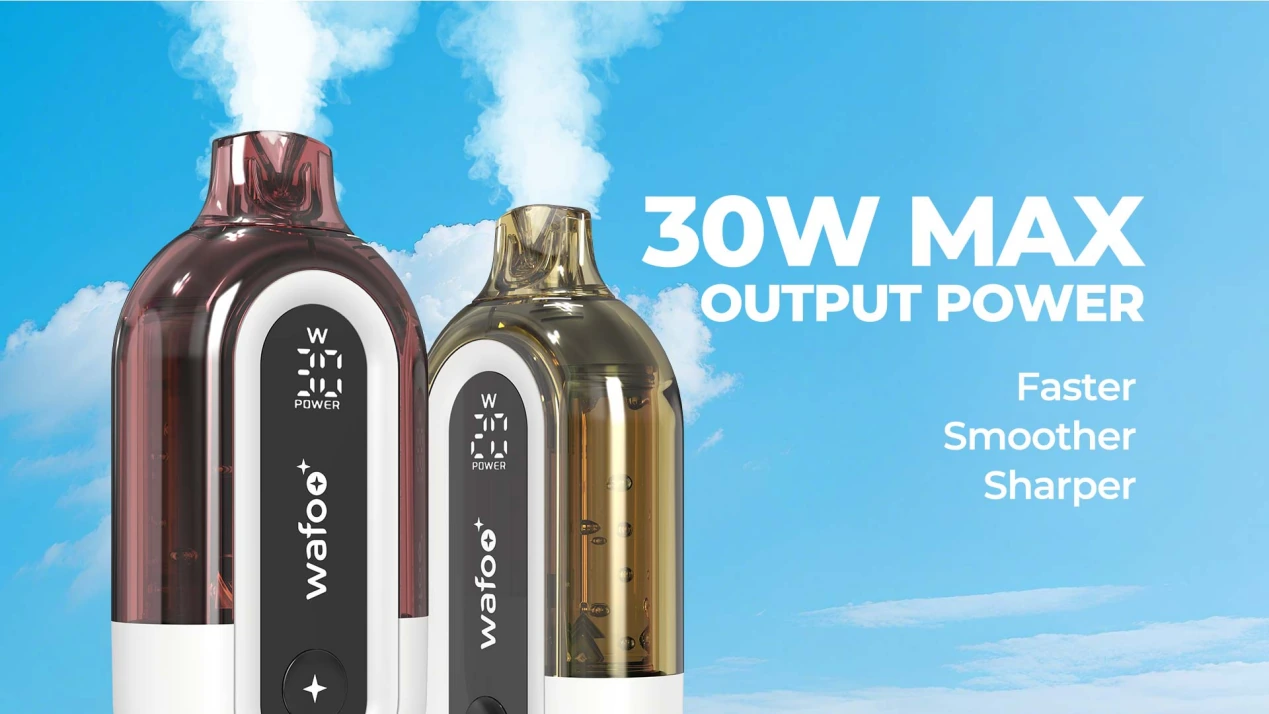
A 30W vape should not be presented as if it operates continuously at 30W. The value may describe only the highest supported output. Sample testing should confirm the available stages, the method used to change them, and whether the screen or indicator matches the final instructions.
Vapor Production and Flavor Perception
A stronger setting may increase heating intensity and vapor output, but liquid formulation, airflow, coil saturation, draw length, and mouthpiece design all affect the result. The difference should be verified across identified samples under the same draw, airflow, and e-liquid conditions.
The benefit of an adjustable voltage vape is controlled choice within a tested range, not a promise that maximum output always gives maximum flavor. One setting may suit a particular liquid or draw style better than another.
Higher output cannot correct poor liquid delivery, unsuitable resistance, or restricted airflow. Each setting needs practical comparison before commercial wording is approved.
Battery and E-Liquid Consumption
Stronger heating can increase energy demand and may increase e-liquid consumption. The scale of the change depends on the selected level, draw duration, frequency, resistance, and device efficiency.
Vape power settings influence both sides of the use cycle. The battery supports electrical demand, while the tank and wick support liquid demand. A larger reservoir cannot prevent low battery status, and a larger battery cannot compensate for inadequate e-liquid supply to the coil.
For a 30W vape, battery capacity should remain separate from maximum output. Milliamp-hours describe stored charge, while watts describe power. Neither value proves a fixed number of hours, days, or puffs.
A fixed-output device removes user-selected power changes, but it does not remove all operating variation. Battery status, draw duration, liquid supply, and control logic may still affect output during use. The comparison is between selectable and preset control, not between variable and perfectly constant performance.
What Power Control Cannot Change
Vape power settings cannot increase tank volume, battery capacity, or coil resistance. They cannot restore depleted e-liquid, repair a damaged component, or force the wick to deliver liquid faster than the structure allows.
An adjustable voltage vape still depends on stable seals, a compatible coil, suitable liquid delivery, and a responsive control circuit. Fixed-output hardware depends on the same fundamentals. Output choice does not replace hardware quality.
Which Output Style Fits the Intended Channel?
The decision should begin with the user routine and retail environment. Some channels can explain several modes clearly, while others need a simpler disposable vape.
Fixed Output for Simple Retail Programs
Fixed output can fit entry-level or convenience-led lines because users are not asked to select among several power stages. It still requires checks for resistance, battery support, liquid capacity, activation response, charging behavior, and consistency across samples.
A preset operating profile may also simplify packaging and staff training. However, fixed output does not mean that performance remains identical throughout the entire product cycle. Battery status, liquid delivery, draw behavior, and component condition can still affect the result.
Adjustable Output for Feature-Led Lines
An adjustable wattage vape can support a higher-feature position when the control creates a visible, repeatable difference. Retail staff should be able to show how settings change and what limits apply. Setting names and indicator behavior must remain consistent across the quotation, sample, packaging, and user guide.
The control should serve a clear product purpose. It may support different draw preferences or output profiles, but it should not be added only to increase the number of specifications shown on the package.
Why More Settings Are Not Always Better
A long menu of modes does not automatically improve a disposable vape. Useful vape power settings should be easy to select, confirm, and distinguish during controlled testing. If two stages show no repeatable difference, the extra choice may add complexity without enough channel value.
How to Test Output Control Before Ordering
A B2B review should compare several identified units under common conditions. One sample cannot show whether a difference comes from the setting or the unit.
Establish the Fixed Baseline
Record the model version, tank capacity, battery capacity, coil type, resistance, charging port, package contents, available modes, and stated maximum output. Use the same e-liquid, fill level, cable, airflow position, rest period, and draw pattern where possible.
This baseline separates fixed hardware facts from variable results.
Compare Every Supported Setting
Run each level separately. Record activation response, visible liquid change, battery indication, sound, perceived warmth, and interruptions. Do not assume that the strongest stage always creates the preferred result.
For an adjustable wattage vape, check the supported power range. For voltage control, confirm whether the display shows voltage, wattage, mode names, or level bars. The commercial specification should use the same terminology.
Repeat the comparison across several samples before treating a result as production-level evidence.
Match the Sample With Final Documents
Keep an approved sample as the physical reference. Setting names, maximum values, resistance, coil, battery, screen behavior, charging guidance, and package contents should match the final order records.
Changes to the control circuit, coil, battery, indicator, or liquid-delivery structure require written approval.
Applying Adjustable Output to a High-Capacity Device
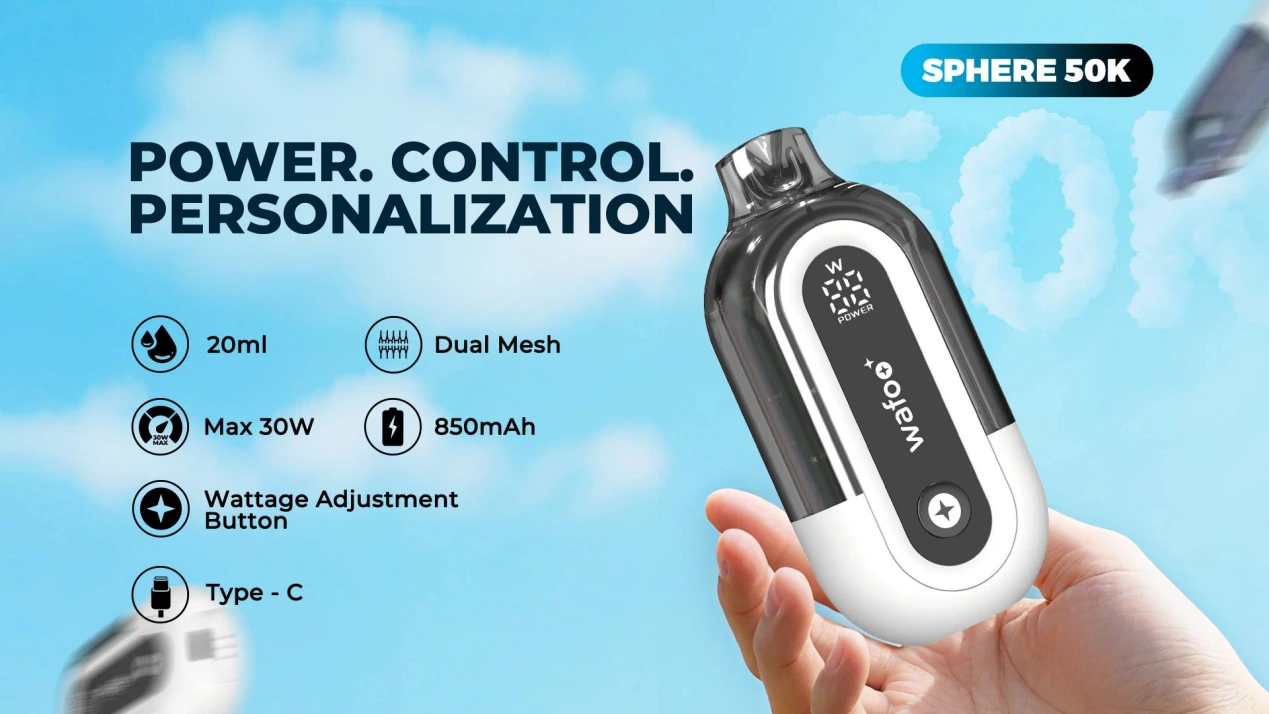
SPHERE 50K uses an adjustable-output system with a stated maximum output of 30W. Its configuration also includes a 20 mL transparent e-liquid tank, an 850 mAh battery, a mesh coil, RGB lighting, a smart display, and Type-C charging.
These values describe separate parts of the device. The 20 mL figure describes liquid capacity, 850 mAh describes stored charge, and 30W describes the stated maximum output. They do not prove a guaranteed operating time or puff result.
As a 30W vape reference, the model is useful for reviewing control logic rather than suggesting that maximum output is always preferable. The control and display behavior should match the approved sample and market version.
Wafoo develops disposable, pod-system, and e-liquid formats. Product selection still depends on the target user, destination market, packaging, nicotine configuration, and distributor training.
Describe Adjustable Output Without Overpromising
Commercial wording should distinguish the supported range, normal operation, and maximum output. “Adjustable within the supported range” is more precise than “unlimited power control,” while “up to 30W” should not imply constant operation at that level.
Avoid promising that one setting always saves battery, creates stronger flavor, or extends coil life. Those results depend on resistance, liquid supply, airflow, draw behavior, and test conditions. Packaging, instructions, and sales materials should use the same names for every stage and the same vape power settings terminology.
For a broader comparison of capacity, output, and control functions, read Best Disposable Vape Features to Look for in 2026: Power, Capacity, and Control Explained.
Compare the Output Options Before Sampling
Before selecting a fixed-output or adjustable device, define the intended user routine, supported range, coil resistance, battery capacity, tank structure, screen functions, charging method, and training requirements. Review the wider device range after the product tier and control level are clear.
When the brief is ready, share the output, capacity, and market requirements with the product team. A defined test plan makes comparison more useful and reduces changes after packaging approval.
FAQ
Q: Is an adjustable voltage vape the same as an adjustable wattage vape?
A: No. Voltage and wattage describe different electrical values. A device may regulate voltage, target power, or offer preset output modes. Confirm what the control changes, what the display shows, and how the supported range is documented.
Q: Does a higher setting always create more vapor?
A: A higher level may increase heating and vapor output, but the result also depends on coil resistance, liquid supply, airflow, draw length, and device controls. It should not be treated as a universal guarantee of stronger flavor or better performance.
Q: Does a 30W vape always operate at 30W?
A: No. A 30W vape may list 30W as its maximum supported output rather than its constant operating level. Buyers should confirm the available stages, normal operating behavior, and the terminology used on the display, packaging, and specification.