
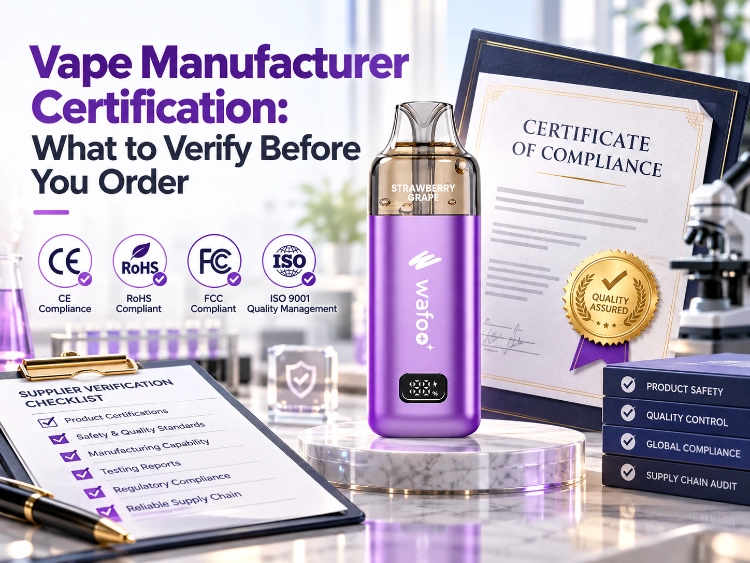
A certificate folder arrived with a quotation: a CE declaration, a RoHS report, an FCC summary and an ISO 9001 sheet. Every page looked complete.
Two readers reached opposite conclusions from the same folder. One started at page one of each document. The other read the logos, decided the factory was certified, and forwarded the folder to the freight desk.
The order behind it ran to 4,000 units of a 16,000-puff disposable, and the declaration had been signed two board revisions earlier. Nothing in the folder was forged. The shipment would still have described hardware nobody was buying.
Three fields decided the review.
Whether the scope line named the ordered model.
Whether the standard edition matched the destination market.
Whether the test date fell after the last board change.
What the Folder Actually Proved
The Quality Certificate Covered the Plant
The ISO 9001 certificate in that folder described the plant and its records. Auditors pulled records, wrote findings, and returned the following year for a surveillance visit. The certificate held for 3 years, with one audit inside each of the first two.
That file held no measurement of a device in an anechoic chamber, and no record of a board at the temperature extremes of a tropical market.
The Declaration Named an Older Board
Page one of the CE declaration carried the scope line in a single sentence. It named a model code, and the code resolved to a board revision that had shipped eighteen months before.

Lab reports follow the configuration that sits on the bench: a board revision, a cell, a coil, a charging circuit. Wafoo builds pod systems and e-liquids and states CE, RoHS and FCC coverage across the range. Matching that statement to one model on one order took a written reply, because hardware moves. A 1300mAh pack where an 800mAh pack once sat counts as new hardware, and a swapped charging IC counts too.
The Four Gaps That Passed the First Look
| Gap | What showed on paper |
| Validity lapsed | The date had passed, the renewal sat at the issuing body |
| Edition superseded | The report cited a standard withdrawn since |
| Wrong level tested | The cell had been tested, the device had not |
| Code mismatch | The certificate named a model the invoice did not |
Fine print hid the first three. The code mismatch took one glance, once the certificate and the invoice sat side by side.
The Three Marks on That Order
CE: What the Declaration Claimed
A rechargeable vape device answered four EU rules at once: what it emitted, how its charger behaved, which substances sat inside it, and how its radio transmitted. A prefilled pod added the e-liquid rules of the destination market on top.
The signature sat at the bottom of the Declaration of Conformity, beneath the manufacturer, the product, the directives and the standards. That sheet has to be kept 10 years past the last unit sold, because inspectors can ask for it long after the launch photo goes up.
RoHS: What the Parts List Left Out
RoHS restricts 10 substances. Nine sit at 0.1% by weight, and cadmium sits at 0.01%.
The parts list decided what the report was worth. Housing, solder and cable jackets: 3 items covered. The cell, the coil assembly and the pod wick appeared on a second sheet, which the first reader requested and the supplier sent two days later.
Product families split the same way. Wafoo’s S 30K pairs Bluetooth with a 25ml fill and up to 30,000 puffs, and the connected model specification lists the radio beside the device specification, so one file has to cover both. A refillable kit such as the ECO S brings a 1300mAh cell, a 2.0ml pod and a 1.47-inch display into the same assessment.
FCC: The ID That Did Not Match
The FCC ID lookup cost nothing. It returned the equipment authorisation with a model code printed inside, and that code differed from the one on the invoice. The buyer made a call, and the supplier issued a corrected file before the deposit cleared.
Two threads ran through that device: the electronics and the radio. One label carries both IDs, and one photograph settles the question.
The Cell and the Transport Summary
The cell had been put through abuse behaviour tests: crushing, overcharging, shorting, heating. The transport test ran separately, and its summary travelled with the goods.
Two audiences wanted two documents. The regulator wanted the first. The airline counter asked for the second while the booking was made, and a pallet without it sat on the tarmac for three days on an earlier order.
Turning the Review Into Order Terms
The List That Went With the Quote
The buyer attached a numbered list to the purchase order, with the commercial terms held in the product and service FAQ.
- the conformity declaration, naming the model and the standards;
- the substance report, with the tested parts written out;
- the radio approval, with the equipment ID;
- the cell safety summary, plus the transport summary;
- the quality certificate, with the issuing body and both dates.
Five lines, five openable documents. The commercial answers sit on that same page: regular products carry a 500-unit minimum, stock ships in 3 to 5 days, and custom builds run 15 to 25 days.
The Sticker Check
Authentication runs on the packaging. We print a sticker with a code under a scratch coating. A scan checks it through the product verification service. The buyer kept a few scans in the order folder beside the certificates, which turned a later batch question into a five-minute answer.
What the Sample Round Showed
Paper met hardware in the sample, and four checks settled it.
The carton label against the invoice code. The display against the approved specification, whether a 1.47-inch panel on a refillable kit or a puff counter on a sealed device. The scratch coating, unmarked. The pod against its drawing, a 2.0ml side-fill tank or a replaceable pod on a 20,000-puff model.
The label check failed first, and the other three never got a chance that week.
Checking Without a Factory Visit
The Lab Register
Every certificate carries a number, and the number sits in a register at the issuing lab. The buyer took 3 fields to that register: the number, the model, the edition. One lookup resolved to a different product, and that finding started the whole review.
Three Questions That Settled It
- Which model codes does this report name?
- Which market, and which edition of the standard?
- What changed in the product after the test date?
All three went out in one message, and the reply landed beside the order number.
The model came first, because this range runs wide. A refillable pod kit puts pods, coils and a device into one file, a sealed disposable carries its own configuration, and models from 16,000 to 30,000 puffs with fills from 16ml to 25ml sit in between, listed in the product range.
Conclusión
Certification answers one narrow question: what was tested, on which configuration, against which edition. That review cost an afternoon, one email and one phone call. It saved a container, a retail listing and an argument about a single unit with no history attached.
Preguntas frecuentes
Q1: Does one declaration cover every model from a factory?
A1: No. It attaches to a product or a defined family, and the scope line names the one it covers. Two pod systems on different boards needed two reports in that review, even though both shared a brand, a carton and a charging port.
Q2: Can the quality certificate replace the product marks?
A2: They covered different ground on that order. The quality certificate described the system and the batch trail. The product marks described the device and its radio.
Q3: What triggers new testing when a model changes?
A3: A new cell, a new charging circuit, a new radio module. Carton, artwork and colour changes triggered nothing on that file, which is why the two cases deserve separate lines in the order terms.