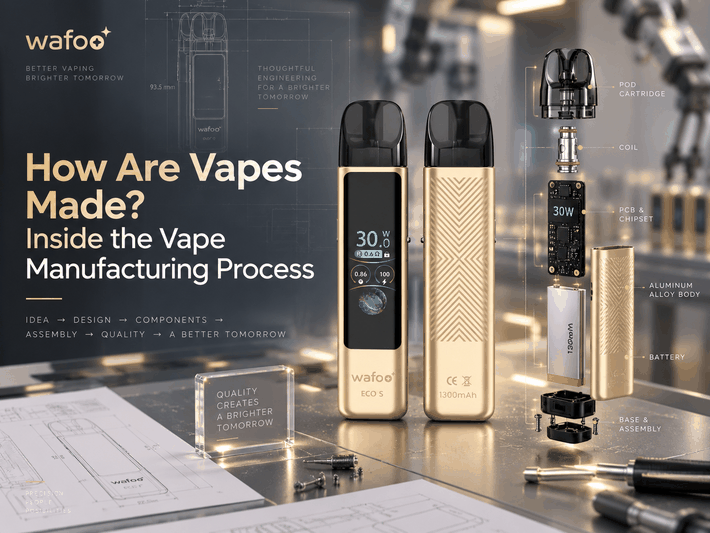
A finished vape device may look simple from the outside, but producing one consistently is not a simple assembly job. A modern vape manufacturing process connects product planning, structural design, atomization, electronics, liquid management, prototyping, assembly, testing, and quality control. Each stage affects what the user eventually feels in the hand and experiences during use. For distributors and brand owners, understanding how vapes are made is especially useful. It helps separate basic e-cigarette manufacturing from a more complete product-development process. A factory may be able to assemble components, but reliable mass production requires those components to work as one system and remain consistent from approved sample to repeat order.
Wafoo develops products across refillable pod systems, transparent-tank devices, adjustable-power products, high-capacity formats, and smart devices. The Wafoo vape range gives a useful view of how different product concepts lead to different engineering and manufacturing priorities.
Where Does the Vape Manufacturing Process Really Begin?
The vape manufacturing process begins before a production line starts.
It begins with a product brief.
A manufacturer first needs to know what the device is supposed to do, who it is for, and which product format best matches that use case. A compact refillable pod, for example, creates different engineering requirements from a high-capacity transparent-tank product or a smart disposable device.
This early stage is where vape product development has the greatest influence over the final result.
Why Must Product Architecture Come Before Cosmetic Design?
Exterior styling matters, but the internal architecture determines whether the idea can actually work.
Battery size affects available internal space. Pod or tank capacity changes body dimensions. Coil resistance influences the useful power range. Airflow affects draw resistance and cooling. A display requires electronics, interface space, and additional power management.
These are connected decisions.
For example, the ECO S refillable pod system combines a transparent 2.0ml refillable pod, adjustable airflow, adjustable power, a 1300mAh battery, Type-C charging, and ceramic-core or mesh-coil options. Its listed resistance options are 0.62Ω and 0.8Ω.
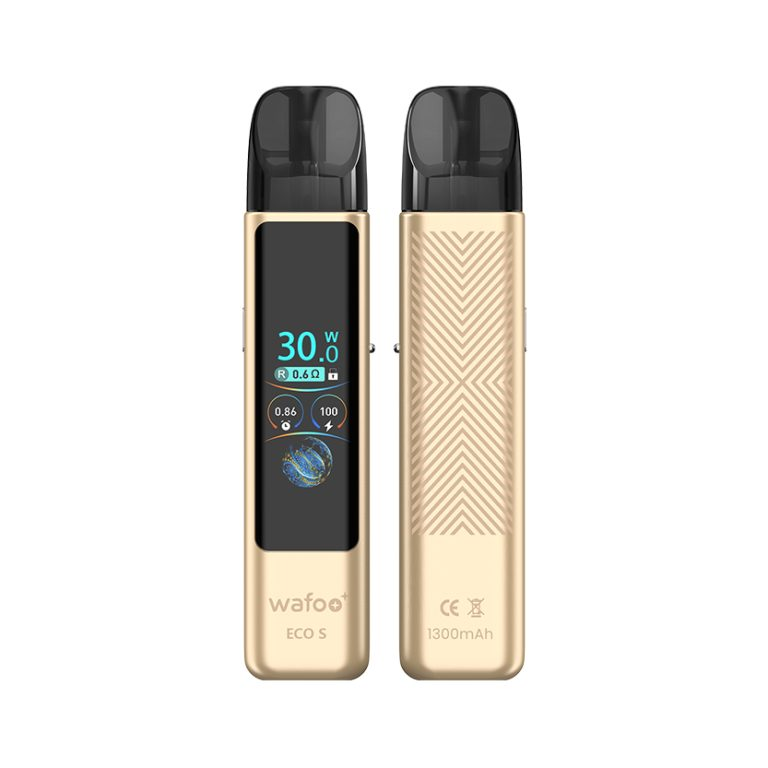
The important point is not any single specification. The battery, airflow, resistance, refillable pod, power adjustment, and display all have to fit the same product architecture.
This is what effective vape product development should establish before the vape production process moves toward tooling and mass production.
What Should a Prototype Actually Prove?
A prototype is not successful simply because it turns on.
It should answer practical questions.
Does the pod fit securely? Is refilling straightforward? Can users see the liquid level clearly? Does the airflow control produce meaningful changes? Are the buttons easy to operate? Is the display readable? Does the complete device still feel balanced once the battery, tank, circuit, and housing are assembled?
Prototype testing should also reveal whether a design creates unnecessary complexity.
If a refill mechanism requires awkward handling, that should be discovered before mass production. If the internal layout makes assembly difficult, that should also be addressed before the vape production process is fixed.
A strong prototype therefore connects design intention with manufacturing reality.
How Does a Vape Move From Prototype to Production?
Once the design has been validated, the challenge changes.
The question is no longer whether one device can work. The question becomes whether many devices can be produced to the same intended standard.
This is where disciplined e-cigarette manufacturing becomes important.
Why Do Component Tolerances Matter?
A vape device combines several functional systems:
the atomization structure, battery, circuit, sensor or activation system, liquid reservoir, seals, mouthpiece, charging interface, display or controls, and outer housing.
Each part may look acceptable individually, yet the final product can still become inconsistent if the parts do not fit together within a controlled tolerance range.
A small difference in a seal can affect liquid containment. Poor alignment around electrical contacts can create inconsistent connection. Variation in airflow passages can change draw resistance. Differences around the atomization structure can influence liquid supply and heating behavior.
For this reason, vape quality control should not begin only after the finished device reaches the end of the line.
It should be part of e-cigarette manufacturing from incoming components onward.
Why Is Assembly More Than Putting Parts Together?
Assembly connects several operating paths at the same time.
There is an electrical path between the battery, circuit, and atomizer. There is a liquid path between the reservoir and heating area. There is an airflow path through the device. There may also be a control path between buttons, sensors, electronics, and the display.
A weakness in one path can affect the others.
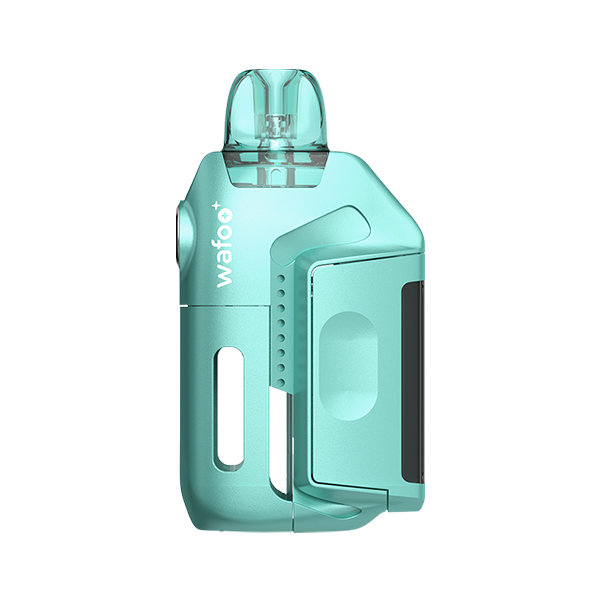
The ECO AWAKE modular system illustrates this relationship clearly. It uses a replaceable 10ml bottle, a 0.6Ω mesh coil, a 900mAh battery, 17W output, Type-C charging, and a fill-and-close liquid-control structure.
Its filling process requires the bottle and liquid path to work with the heating section in a controlled way. After filling, the valve returns to the closed position to reduce backflow. This means the reservoir is part of the operating architecture, not simply a container attached to the device.
Where Should Vape Quality Control Be Built Into Production?
A good vape quality control system works at several stages.
Waiting until final inspection is inefficient because some defects are created much earlier in the vape production process.
What Should Be Checked Before Final Assembly?
Incoming component checks can focus on the characteristics that directly affect product function.
Depending on the device, that may include dimensional fit, electrical connection, pod or tank interfaces, charging components, sealing parts, buttons, screens, or other critical components.
The goal is not to inspect every characteristic with the same intensity.
The goal is to identify which characteristics are important enough that variation could affect the final device.
Production-stage checks then help determine whether the assembly process is staying within the approved condition.
A refillable device, for example, creates different checkpoints from a simpler disposable structure. An adjustable device adds additional control and interface functions that also need verification.
Why Must Finished Devices Be Tested Like Real Products?
A device can look correct and still perform poorly.
Final vape quality control therefore needs functional checks, not only visual inspection.
The relevant questions include whether the device activates properly, whether charging functions normally, whether the output and controls behave as intended, whether the pod or tank sits correctly, and whether the liquid system remains properly contained.
Products with more visible information also create additional expectations.
A transparent tank should make the remaining e-liquid genuinely easy to see. A smart display should provide useful, readable information. An adjustable control should create predictable changes rather than simply adding another button.
The point of testing is to confirm that the original vape product development decisions have survived the manufacturing process.
How Does Atomization Technology Affect Manufacturing?
The atomization system is one of the most important areas where design and production meet.
Wafoo’s product development has moved through horizontal coil, mesh coil, and dual-mesh configurations across different product generations. Later product directions also added adjustable power, replaceable pods, transparent liquid systems, and smart interaction.
These changes make modern e-cigarette manufacturing more dependent on system integration.
Why Can’t the Coil Be Evaluated Alone?
The coil does not work by itself.
Its performance depends on liquid delivery, resistance, power, airflow, and heat management.
A larger or faster heating structure may require more reliable liquid supply. Higher output changes heat generation. Airflow changes cooling and vapor density. The pod structure determines how liquid reaches the heating zone.
That means atomization design should be validated as part of the complete product rather than selected from a component list and tested in isolation.
This is also why two devices that both advertise “mesh coil” can perform differently.
The phrase describes one part of the system, not the complete system.
Why Do Different Vape Products Need Different Manufacturing Priorities?
There is no single ideal architecture for every market.
A compact refillable pod prioritizes different things from a large-capacity adjustable product.
A smart device adds yet another set of requirements.
The SPHERE 20K product design combines a replaceable pod, dual mesh, adjustable ice, intelligent display, Type-C charging, and an 800mAh battery. Its product priorities differ from ECO S even though both belong to the broader pod-system category.
The SPHERE 20K needs its pod system, cooling adjustment, atomization, power system, and interface to work together around a different product goal.
This is why a mature vape production process should not force every product through exactly the same evaluation logic.
Manufacturing standards can remain consistent while the critical checkpoints change according to product architecture.
What Does Good Manufacturing Mean for a Distributor?
For a distributor, manufacturing quality becomes visible in several practical ways.
First, production units should remain close to the approved sample.
Second, later repeat orders should maintain the intended product configuration.
Third, different models should have clear product roles rather than being cosmetic variations with little technical distinction.
Fourth, product specifications should make sense together.
A manufacturer that develops multiple architectures can also give a buyer more room to build a differentiated portfolio.
Wafoo currently covers refillable pods, transparent liquid systems, adjustable products, replaceable structures, high-capacity devices, and smart functions. That broader development range allows buyers to compare different product directions rather than simply choosing different shells around the same basic concept.
What Should Buyers Ask Before Starting Production?
A useful supplier discussion should go beyond price and production capacity.
Buyers can ask:
How does a new concept move from brief to prototype?
Which specifications become fixed before production?
Which product characteristics are checked during assembly?
How are functional changes handled after sample approval?
Which parts of the device are standard and which are customized?
How are repeat orders kept aligned with the approved configuration?
These questions reveal more about the actual vape manufacturing process than a general statement such as “strict QC.”
For projects that need a standard product, modified configuration, or deeper development input, buyers can discuss product requirements with Wafoo before finalizing specifications and order planning.
Conclusion
So, how are vapes made?
The useful answer goes far beyond assembly.
A reliable vape manufacturing process starts with product positioning, turns that idea into a workable architecture, validates the design through prototypes, controls components and assembly, and uses vape quality control to protect the approved product during production.
Strong e-cigarette manufacturing also depends on strong vape product development. The battery, atomization system, liquid path, airflow, interface, and housing need to work as one product before the factory tries to reproduce that product at scale.
For B2B buyers, this is the real value of understanding the vape production process. It helps them judge not only whether a supplier can make a vape, but whether that supplier can repeatedly manufacture the product they actually approved.
FAQs
Q1: What are the main stages of the vape manufacturing process?
A1: A typical vape manufacturing process includes product definition, structural and electronic design, prototype validation, component preparation, assembly, production-stage checks, finished-device testing, vape quality control, packaging, and preparation for distribution.
Q2: Why is vape product development important before mass production?
A2: Vape product development determines how the battery, atomization system, liquid path, airflow, controls, and housing work together. Solving these relationships before mass production reduces unnecessary changes later and gives the vape production process a clear approved target.
Q3: Is vape quality control only a final inspection?
A3: No. Effective vape quality control should be integrated into incoming-component checks, production-stage verification, and finished-device testing. This gives e-cigarette manufacturing better control over variation throughout production.