
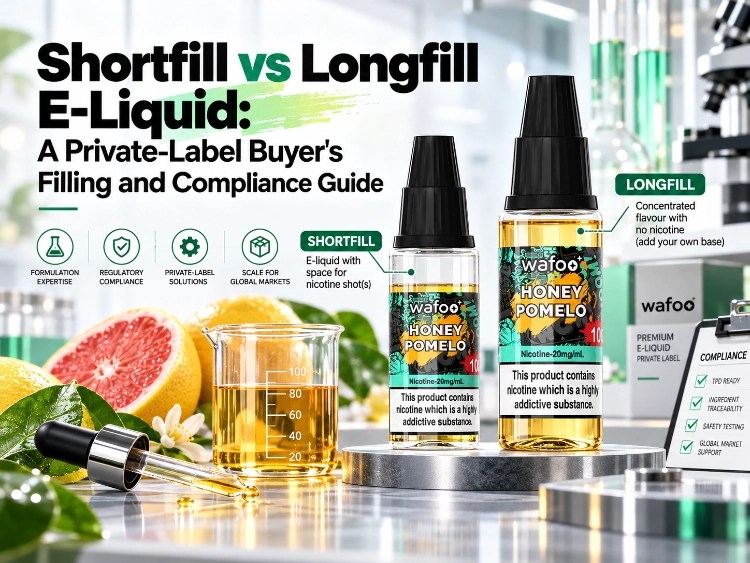
Put “50ml of mango in 3mg” in front of a contract filling line and the quote comes back as a shortfill, whereas asking instead for “10ml of mango ready to vape at 20mg/ml” produces a longfill quote — or a blunt message that the destination market forbids the first request and legislates the second. Private-label buyers lose more money over this pair of words than over almost anything else in the category, because the format decision fixes the filling volume before a single term gets negotiated. Format decides what strength may legally be printed on the label, it decides carton count per pallet, and it decides whether the bottle may cross a border into the EU, the UK, or a nicotine-capped US state at all.
One paragraph settles the vocabulary before anything else. A shortfill is an oversized bottle of zero-nicotine or low-nicotine liquid, deliberately underfilled so that the buyer adds nicotine afterwards — 50ml of flavour liquid in a 60ml bottle with a nicotine shot riding alongside — while a longfill is a bottle of flavour concentrate with room left for nicotine solution and base both, roughly 100ml of concentrate in a 120ml bottle, which the consumer finishes mixing. The first format is a compliance workaround that Europe’s regulated market invented, and the second is hobbyist economics that survives wherever nicotine-free liquid at volume stays legal, so neither is better in the abstract. What follows are the definitions that survive a purchase order, the mixing arithmetic, what the filling plant controls, what you have to verify yourself, and which channel wants which bottle — the aim being that a first private-label order ends up specified correctly instead of relabelled in a panic.
Shortfill vs Longfill: The Definitions That Matter Operationally
Shortfill: underfilled bottle, add nicotine
Inside a shortfill bottle there is flavour, VG/PG base, and headspace, but nicotine in any meaningful quantity? None — or nothing above some declared figure on the paperwork. The consumer’s other half of the purchase is a nicotine shot, nic shot in the trade: a small 10ml or 20ml bottle of unsweetened nicotine-in-base at a fixed concentration, usually 18mg/ml or 20mg/ml, and one 10ml shot of 18mg/ml poured into a 50ml shortfill gives roughly 60ml finished liquid at 3mg/ml. Nothing about that arithmetic wanders, it repeats identically in every kitchen, and the brand owner prints the ratio on the label so that the customer never has to think about it.
Why would anybody design a bottle that needs a second bottle to work? The answer is the European Union’s Tobacco Products Directive, which pins refill liquid at 20mg/ml nicotine and the container at 10ml — a 50ml bottle holding 20mg/ml nicotine is unlawful in a TPD market and always will be, while a 50ml bottle of nicotine-free liquid sitting next to a compliant 10ml nicotine container occupies a different regulatory position, one the trade has lived inside for years. Shortfills are simply what a category builds when customers still want a large, high-VG, flavour-forward product and the legislature still wants small nicotine packages, so the format is the workaround rather than a preference.
Longfill: flavour concentrate, add base and nicotine
The longfill flips the economics, because the concentrate — occasionally pre-blended with base already — fills the bottle well below capacity and the user finishes the job twice over, first a nicotine shot and then quite often a shortfill-style base or straight VG on top. Take a 120ml bottle carrying 100ml of concentrate at a 20% flavouring load: two 20ml shots of 20mg/ml land you near 160ml at about 5mg/ml, and reaching for extra base instead grows the volume while thinning the strength.
What the programme actually ships tells you where the money is, since value lives in the flavouring rather than the pallet volume — freight behaves better and a nicotine-free concentrate outlives a nicotine-salt solution on the shelf easily. The risk is a customer with bad arithmetic: add the wrong shot count and the finished liquid turns harsh and over-nicotinised, and here is the sting — nobody blames their own maths, they blame your bottle, your artwork, and your brand. Longfill programmes therefore live or die on label-face instructions and customer education, which makes the concentrate itself the easy part.
Reading the two formats against each other
At the point of sale a shortfill bottle contains finished flavour liquid with no nicotine worth declaring, while a longfill contains a concentrate that is sometimes pre-blended with base; the shortfill user contributes only a nicotine shot, whereas the longfill user contributes a shot and often extra base besides. The typical bottle tells the same story — a 60ml bottle carrying 50ml of liquid against a 120ml bottle carrying about 100ml of concentrate — and so does where the value concentrates, since a shortfill ships flavour, base, and shipping volume while a longfill ships the flavour system and hands the rest of the volume to the customer. User-error exposure runs low on one side (one shot, printed ratio) against high on the other (multiple additions), freight per saleable litre runs high while shipping mostly liquid against lower once the user adds part of the volume locally, and final strength ends up controlled by the printed ratio at user end in one case and by the user’s own choices in the other.
Nicotine Shot Arithmetic, and What It Does to Draw
If the label team cannot do this arithmetic, it cannot QA a label, because one mass balance carries everything: final strength in mg/ml equals shot volume times shot strength divided by final total volume. Four examples are worth taping above the artwork desk — a 50ml shortfill plus a 10ml shot of 18mg/ml gives 60ml at 3mg/ml; the same bottle plus a 10ml shot of 20mg/ml gives 60ml at 3.3mg/ml; a 20ml shot of 20mg/ml into the same shortfill gives 70ml at 5.7mg/ml if the bottle has room for it; and a 100ml longfill taking two 20ml shots of 20mg/ml lands at 140ml of 5.7mg/ml liquid.
Then come three consequences that nobody puts on the quote. First, the VG/PG ratio is not final until the shot lands, because freebase shots run 50/50 as a rule and a 50/50 poured into a 70/30 high-VG shortfill drags the finished liquid toward 60/40, thinning the vapour the brand spent money positioning — “cloud chasing” printed on a bottle that ends at 60/40 in the tank is a lawsuit against your own marketing, so either specify a high-VG shot on the label or accept that the draw changes. In the other direction, Wafoo’s mesh-coil devices across its pod system range sit at modest wattages that reward mid-VG liquid, and pushing a 70/30 shortfill into a low-wattage pod produces dry-hit complaints that arrive dressed as device defects.
Second, salt is not freebase at the same number on the label. Lower pH, a smoother throat at 20mg/ml, faster uptake — the printed milligram figure hides all of it, salt shots belong in low-power high-resistance small-capacity hardware, and 3mg/ml freebase belongs in bigger warmer devices, so selling “3mg” as one experience across both guarantees the retail partners will describe the difference for you, loudly. Third, mixers overshoot: the longfill customer who drops in a shot, tops up with unshot base, reconsiders, and then adds a second shot has built harsh liquid out of a perfectly specified concentrate, which is why the full ratio table belongs on the bottle face — a leaflet survives approximately one week in a real bag, the bottle does not.
Private-Label Filling: What the Plant Controls and What You Verify
Filling and dosing control
Nicotine is scheduled handling material in nearly every market, and that classification turns dosing accuracy into a safety property rather than a quality preference, so five questions belong in writing before artwork approval. How does nicotine enter the product — batch tank with verified in-line mixing, or bottle-by-bottle dosing? — because documented homogeneity testing on batch mixing is the shortfill standard, and in-bottle dosing exists but demands its own validation protocol before either gets trusted. What tolerance surrounds the declared strength, since regulated markets expect delivered nicotine inside a tight band of the claim (±5–10% finished strength covers most stated practice) and the facility should state what it commits to and which test method proves it, a certificate without a method being stationery. What happens between a 20mg/ml batch and a nicotine-free one, because the same line without validated cleaning produces a mislabelled product slowly and quietly — flush volumes, changeover SOP, and signed records, that trail rather than a promise. Which analytical release testing actually runs, since an independent third-party assay on retained samples is the seam between a supplier file you could defend and a marketing PDF nobody could. And finally whether a finished bottle can point backward through bottle batch to flavour lot to nicotine lot, because a withdrawal you cannot scope to specific lots is a withdrawal of everything ever shipped.
Label and capacity compliance
Every EU or Northern Ireland order lives inside the TPD’s numbers: refill containers of nicotine liquid capped at 10ml and 20mg/ml, device tanks and cartridges at 2ml, health warnings across a fixed share of the packaging face, ingredient declaration, child-resistant and tamper-evident bottles — national authorities enforce, and in Great Britain the MHRA runs the notification scheme. Buyers should internalise one causal chain, since the 10ml / 20mg/ml ceiling is the reason shortfills exist in Europe and it is also why EU-facing private-label work gets quoted SKU by SKU and market by market instead of as one continental price.
Three label items gate everything else. The capacity class comes first — the 60ml shortfill bottle must stand documented as nicotine-free liquid at point of sale, because pre-mixing nicotine past the container limit ends the compliance question and starts an unlawful package. Warning area and artwork come second, since warning size is a percentage of printable surface and changing the label or the bottle silhouette restarts the compliance review, so freeze geometry before artwork sign-off rather than after. Notification lead time comes third, because EU and UK filings precede legal sale and the registration period runs in months — launch calendars that book filling slots before the notification date is achievable will fill cartons for bonded storage. Devices carrying liquid run on their own track, as a pod kit’s TPD certification history and a liquid’s notification are two workstreams and a customer may only sell when both close; pre-filled disposable devices double the point, since the reservoir was fixed at the factory and the volume ceilings apply to the hardware chosen rather than to a bottle specified.
Filling format versus device ecosystem
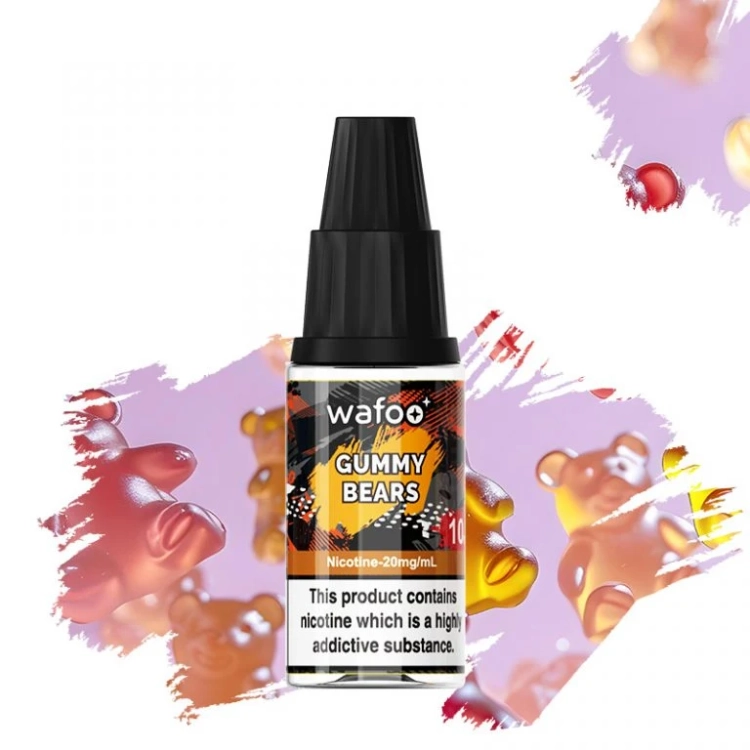
The sharper private-label question is never shortfill-versus-longfill in the abstract but what a given bottle sells next to. A 10ml salt bottle exists for refillable pod systems — ten seconds to top a 2.0ml pod, a re-buy every week or two, a customer who never owns a mixing problem — while a 60ml high-VG shortfill exists for sub-ohm tanks and direct-lung hardware, whose buyer even expects different ergonomics, a needle tip for tight deck ports against a wide spout for open glass. Put the cloud-chaser shortfill in front of a pod-kit base, or the 10ml salt in a mod shop, and the returns will come back for taste, which are the complaints no marketing budget has ever repaired. Wafoo’s e-liquid range exists behind its pod and disposable platforms as the manufacturer’s answer to the same pairing problem — liquid specification written from the device it was engineered for — and private-label buyers without their own hardware line have to do that pairing by hand at quote stage, against the resistance and wattage bands the device manufacturer publishes.
Which Format Fits Which Channel and Market
Four questions settle most of these decisions, ordered by how badly each one hurts when skipped. The first asks whether the destination market caps capacity, because the EU, Great Britain’s own regime, and Turkey-style regimes cap nicotine liquid by volume and strength, and wherever caps apply the answer is prefilled: shortfills for the big flavour products, 10ml salt bottles for the pod users, longfills only where a concentrate framing actually survives local law. The second asks what hardware the customer already owns, since mod-and-tank people buy 50ml, mix, and never complain while pod people buy 10ml and mix never — a retailer whose whole wall is pod kits should hear “10ml ready-to-vape” even when the shortfill margin photographs better, because liquid nobody can use doesn’t sit, it resells itself at a discount eventually at somebody else’s counter.
The third question is price sensitivity of the shelf, since longfills win where the shopper enjoys saving money by arithmetic and shortfills win where the shopper pays for one addition instead of three and never thinks about the difference. The fourth asks what freight costs right now, because a bottle that is mostly liquid, flying, is water and glycol at cargo rates, while a longfill hands part of the finished volume to base the customer adds locally — a material cut to landed cost per saleable millilitre wherever that concentrate framing is legal. Run the model against a real rate rather than a remembered one, as the answer flips with the shipping market more often than any spreadsheet believes. A first programme should therefore look something like a shortfill core line of three to six flavours with one strength path and the ratio table printed where eyes go, plus a 10ml salt line for the pod users in the channel (Wafoo’s UK range roster is a neat study in how a brand structures 10ml flavours for a capacity-capped market), and no longfill at all until one of the four questions actually forces the decision.
How a Private-Label Order Actually Runs
The sequence runs in a familiar order, and the decision points inside it stay yours. Market and format get locked first — countries named, capacity and strength limits confirmed, the shortfill/longfill/10ml mix fixed on paper — followed by flavour development and stability work, meaning sampling and then accelerated ageing plus light exposure on the shortlist, because a flavour that shifts hue or loses its top notes after 90 days at 40°C will not survive one shipping season, let alone a retail year. Base and strength specification comes next: VG/PG ratio, freebase or salt, target strength, acceptance tolerance, and the on-pack shot ratio table drafted now rather than after filling. The compliance file assembles around ingredient declarations, emissions or release documentation per destination market, notification filings in, and artwork carrying health warnings at correct area percentages. A filling trial follows — a pilot batch with retained samples assayed before the commercial run, since dosing drift and headspace variance caught at one pallet’s exposure beat five containers’ worth of learning — then production with retention and release: batch traceability, third-party assay, certificates per lot, filed by your team rather than promised by theirs. Market placement closes the loop with SKU-level sell-through review, remembering that two soft flavours inside a six-flavour line describe a flavour problem rather than a format verdict; fix it by swapping flavours on the next batch, because pivoting format over a soft flavour is expensive superstition.
Conclusion
Nobody ever framed a format decision as packaging preference, yet that is broadly how it gets run in meetings, and format is really the purchase-order decision that fixes the compliance ceiling, the mixing economics, and the freight bill before one carton moves. Shortfills buy regulated volume — flavour in big bottles, nicotine in 10ml shots that pass, one clean addition for the customer — while longfills buy concentrate economics, cheap freight per saleable millilitre paid for by handing the brand’s reputation to the customer’s arithmetic. Start with a shortfill core, stand up a 10ml salt line wherever pod devices dominate the channel, and keep longfills in reserve until freight or price pressure genuinely justifies the education cost they carry. Lock the market and the format first, assay the dosing with your own lab, and let the notification calendar run the schedule, because everything else on the order waits behind it.
Frequently Asked Questions
Q1: Is a shortfill the same as a longfill?
A: One word apart and two different formats. A shortfill bottle carries finished, flavour-complete liquid to which the user contributes only a nicotine shot, while a longfill carries a concentrate the user dilutes with nicotine solution and usually extra base besides — shortfill headspace leaves room for one shot, longfill headspace leaves room for the entire rest of the bottle.
Q2: Why are EU shortfills nicotine-free when sold?
A: Regulated refill containers stop at 10ml and 20mg/ml, so selling the 60ml flavour nicotine-free and handing the nicotine over separately in a compliant 10ml shot keeps the large format lawful. This is structure rather than preference — remove the caps and the format loses its reason to exist.
Q3: Can I put 20mg/ml nicotine in a 50ml private-label bottle for the EU?
A: No. The strength ceiling applies to the nicotine liquid as sold and the container cap sits on top of it independently, so a pre-filled 50ml at 20mg/ml fails the container limit outright, and dressing it up as a concentrate walks straight into the declaration rules. Shortfill plus separate shots is the lawful specification — write it that way.
Q4: Which format is cheaper to import?
A: Per saleable millilitre landed, longfills usually take it because you ship concentrate and the customer adds volume locally; per saleable bottle with zero user error, shortfills take it because nothing rides on the consumer’s mixing. Model both against a live freight rate before committing anything, since when fuel prices move, so does the winner.