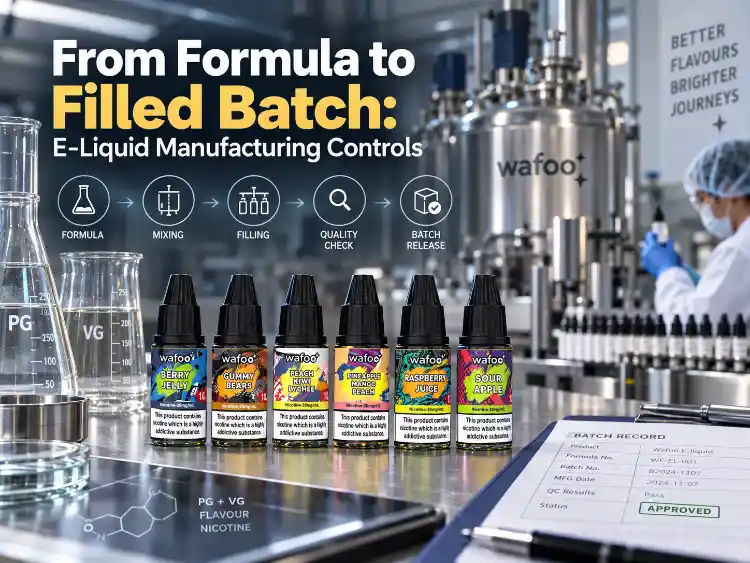
A controlled e-liquid manufacturing line is a production sequence, not a single mixing step. The process begins with raw materials and a defined formula, moves through mixing and a standing period, and continues through quality checks, filling, packaging and batch release. Before placing a private-label or custom order, the buyer needs to understand those controls well enough to ask the right questions.
The commercial decision is not only about capacity. Capacity alone does not show whether the supplier can mix liquid at scale while providing visibility into material records, batch consistency or brand-specific customization. The useful comparison therefore connects process control to the buyer’s product format, target market and order plan.
Start With Raw Materials and Formulation Control
The first control point is the raw-material list. The raw-material list commonly includes high-purity propylene glycol, vegetable glycerin, nicotine solution and food-grade flavourings. The exact combination belongs to the approved formulation, and each material should be identified by its supplier specification, incoming lot and release status. Do not assume that two liquids described with the same broad ratio will behave identically in the same device or filling line.
Formulation control also means change control. If a raw-material source, flavour component or concentration changes, the manufacturer should document the change and determine whether a new sample or stability check is needed. That record protects both the brand and the production team from an unplanned batch-to-batch shift. The published e-liquid product format can be reviewed as a starting point, but the exact formulation for a new project still needs its own confirmation.
A useful formulation brief identifies the intended flavour direction, nicotine format, target device or pod, filling format and destination market. It should also state which requirements are fixed and which can be adjusted during sampling. If the brief is vague, the manufacturer has to guess, and the first sample may answer the wrong question.
Control Mixing and the Standing Period
Mixing turns the approved materials into a consistent batch. The order of addition, mixing method, temperature and duration all influence how thoroughly the components combine. A controlled process records those parameters rather than relying on an operator’s memory. The record should identify the batch, the materials used, the equipment or line, the actual values and the person responsible for the release decision.
After mixing, the liquid may need a standing period so the flavour profile can mature. This step is not decorative waiting time. It gives the manufacturer a defined point at which the batch can be checked against the approved sensory and process criteria before filling. The length of the period and the release criteria should come from the manufacturer’s documented process and the specific formulation.
Set the Mixing Sequence and Records
The mixing sequence should be written for the actual formula. Some components may be added in a specific order to support dispersion, while others may require a defined pre-mix. The production record should show that the intended sequence was followed and that any deviation was reviewed before the batch moved forward.
Batch records are also the buyer’s evidence trail. They show what was produced, when it was produced and which materials were used. A supplier that can explain its record structure is easier to evaluate than one that can only describe the finished flavour. Ownership of the confidential formula is not required, but the supplier should be able to demonstrate that a controlled process exists.
Define the Standing and Release Check
The standing period should end with a defined release check. That check may include visual, sensory or analytical criteria selected for the product and market. The important point is that the batch is not released to filling simply because a set number of hours has passed. The release record should state what is checked, who approves the result and what happens when the result falls outside the approved range.
A sample can be drawn from the mixed batch before filling so the buyer can evaluate flavour direction and consistency. Sampling should follow the approved batch record so the sample represents the production material, not a separate laboratory mixture. When the sample changes after the buyer’s feedback, record whether the change affects the formula, the process or only the packaging format.
Build Quality Checks Into the Process
Quality control should be distributed across the manufacturing process. Incoming-material checks, in-process controls and final product testing answer different questions. A final inspection cannot prove that the correct raw material was received or that the mixing sequence was followed. The process owner should explain which control point owns each risk, what is checked, what record is created and who approves the result.
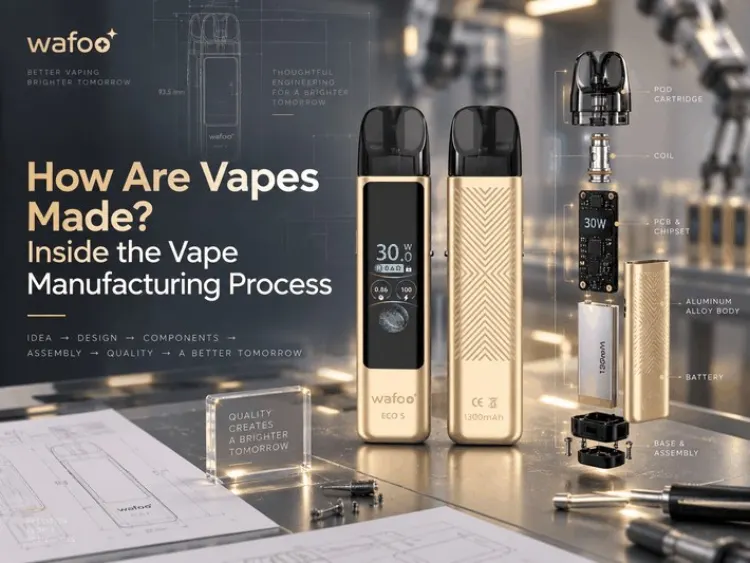
The vape manufacturing process follows a similar logic: material handling, component assembly, product testing and final production all need defined controls. The liquid process adds formulation, mixing and filling controls to that general production framework. Factory evaluation should ask how those controls connect rather than treating each department as an isolated capability.
Check Incoming Materials
Incoming materials should be identified, documented and released before use. Supplier specifications, lot identification, storage conditions and any incoming test or certificate should be confirmed for the material. A mismatch between the approved material and the delivered lot should stop the batch until the issue is resolved.
Storage is part of the same control. Temperature, light exposure, humidity and segregation requirements depend on the material and the manufacturer’s documented system. Ask how materials are stored, how stock is rotated and how the production team prevents an unapproved lot from entering the mixing area.
Release the Filled Batch
Final release should connect the batch record to the filled product. Final release confirms that the approved liquid was used, that the filling and packaging steps match the order, and that the required final checks have been completed. Any retained sample or reference material should be identified with the batch so it can be reviewed later if a question arises.
Also confirm how deviations are handled. A deviation is not automatically a failed batch, but it needs a documented review before release. The deviation record should explain who approves the decision, what evidence is considered and how the buyer is informed when the deviation affects the agreed specification.
Evaluate the Manufacturer and Private-Label Scope
The evaluation should compare the production process with the commercial scope of the project. Does the supplier support the intended liquid format and flavour direction? Can it provide the required sample, product testing, quality records and production window? Does it offer the customization needed for a private-label product, or does the buyer have to coordinate several suppliers?
For manufacturer selection, the strongest evidence is a documented workflow that can be explained from raw material to batch release. Ask for the quality-control points, the batch-record structure and the sample process. A supplier that can answer those questions clearly is easier to compare than one that only presents a product catalogue.
Private label e liquid manufacturing adds another layer. A private-label project may need a custom flavour, a specific bottle or pod format, brand packaging or a market-specific label. OEM/ODM support can include custom design, functions and brand packaging, but confirm which parts of that scope apply to the exact project, especially when formulation, packaging and regulatory requirements must align. The private-label manufacturing page explains a related device-focused example, but the e-liquid project still needs its own specification review.
Align Filling, Packaging and Order Planning
img.Flavoured liquid format for production order planning.png
Once the formulation and manufacturing path are approved, the buyer can plan filling and packaging. The filling format affects the liquid volume, closure, label and product presentation. The packaging format affects protection, storage and shipping. Both should be confirmed against the exact e-liquid product rather than copied from a different SKU.
Samples should be evaluated in the intended format. If the buyer approves a flavour in one bottle or pod and then changes to another format, the filling process and product presentation may change as well. Confirm the sample requirement, the production quantity and the destination market before locking the schedule. Samples can be requested and sample fees are refundable upon a bulk order; for regular products, the MOQ is 500 units, while custom orders require a sales discussion.
Delivery planning should also reflect the actual project. In-stock items ship within 3–5 days, while custom orders take 15–25 days, according to Wafoo’s published FAQ. Those windows are general, so the buyer should confirm the schedule for the exact formulation, packaging and destination. A realistic plan includes sample approval, raw-material availability, mixing, filling, quality checks and shipping. When the product uses a specific flavour format, such as the Peach Juice EU version, confirm that the formulation, label and packaging version match that market.
Conclusion
The manufacturing sequence becomes easier to evaluate when the buyer follows these controls: raw materials and formula, mixing and standing, incoming and final quality checks, manufacturer scope, and filling and order planning. Each step reduces uncertainty for the next one. Do not approve a private-label formula without a representative sample, and do not lock a production schedule without confirming the filling format, packaging and destination market. Share the intended flavour direction, liquid format, target quantity and market with Wafoo so the team can confirm the manufacturing brief before the next production step.
FAQs
Q1: What should be confirmed before choosing a manufacturing partner?
A1: Confirm the raw-material and formulation controls, mixing and standing process, batch records, incoming and final quality checks, sample process, private-label scope, filling format and delivery assumptions. Also verify that the manufacturer can support the exact product and destination market.
Q2: How do mixing and standing affect e-liquid consistency?
A2: Mixing integrates the approved materials, while the standing period gives the batch a defined maturation and release point. Both steps should have documented parameters and release criteria so one batch can be compared with the next.
Q3: What quality checks should a manufacturing partner document?
A3: The manufacturer should document incoming-material checks, in-process controls, mixing and standing records, filling checks and final batch release. The exact tests depend on the formulation and market, but the record should show who approved the batch and what evidence supported the decision.